<link rel="stylesheet" href="styles-HECP4DDU.css"> Skip to main content

Universal Robots Blog

Robots within reach - That's what this blog is all about.

289 posts

showing

  • Blog

Teradyne Robotics achieves IEC 62443-4-1 ML3 certification

As industrial automation becomes increasingly connected, cybersecurity has moved from an IT consideration to a critical operational requirement. Today, Universal Robots is proud to announce that Teradyne Robotics has achieved IEC 62443-4-1 Maturity Level 3 “ML3” certification.

  • Blog

Why 20 kg Is Never Really 20 kg: Understanding Payload Curves and CoG Offset

Learn why two robots rated for the same payload can perform differently. Understand payload curves, center of gravity offset, and how to properly size a collaborative robot application.

  • Blog

Testing Agentic Physical AI on UR Cobots

What we tested with the Model Hardware Standard (MHS) research preview — and why PolyScope X is the platform that gets us there.

  • Blog

How do you teach robotics for an industry that keeps moving?

Engineering curricula struggle to keep pace with AI-driven automation. A free, university-built curriculum suggests a more durable answer than constant rewriting — and no robot is needed to get going.

  • Blog

Ergonomics, accuracy, and throughput: Why quality teams are turning to cobots

Quality inspection often breaks down due to fatigue and repetition, not lack of standards. Explores how cobots help quality teams improve accuracy, protect inspectors and increase throughput by taking on the most physically demanding inspection tasks.

  • Blog

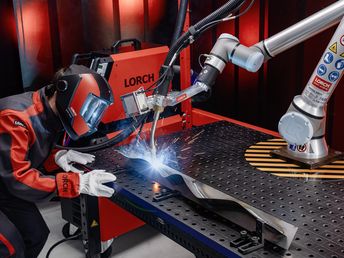
How AI welding automation cuts downtime and defect rates

Skilled welders are scarce, and traditional robots are difficult to program. Discover how AI-powered cobots simplify programming for high-mix, low-volume welding.

  • Blog

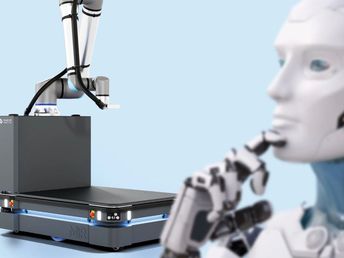
Humanoids or purpose-built robots: What manufacturers hear when the hype fades

Humanoids are everywhere right now. For manufacturing leaders already under pressure to improve productivity, the question is unavoidable: is this something we should be planning for?

  • Blog

Why direct torque is the missing signal in imitation learning

Imitation learning systems trained only on motion and vision break down when robots make real contact with the world. Direct Torque Control exposes force and physical interaction as first‑class signals, allowing learning models to capture intent, adapt during contact, and transfer more reliably from lab settings to production environments.

  • Blog

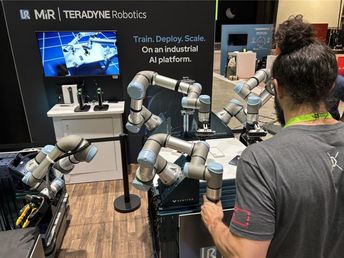
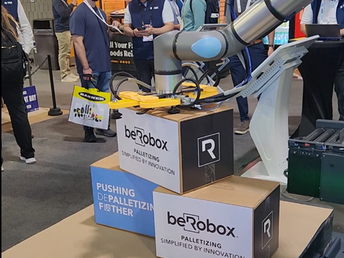
Adapting to the messy reality: Why MODEX 2026 was the year of flexible automation

MODEX 2026 made clear that the era of the ‘perfectly programmed grid’ is over. As I spoke with visitors at our booth, a profound shift became clear: companies are increasingly on the search for physical AI and robotics that react on the fly to real-world variability.

  • Blog

Physical AI: Five questions from the factory floor

What does Physical AI really mean on the factory floor? Universal Robots’ VP of AI Robotics answers five real-world questions from manufacturers, covering safety, validation, performance, and where Physical AI still falls short.

  • Blog

Imitation learning is reshaping the training of physical AI for industrial environments

Imitation learning is changing how industrial robots are trained, shifting from rigid programming to learning through real-world interaction. Anders Billesø Beck explains why data quality, force and production-grade hardware matter.

  • Blog

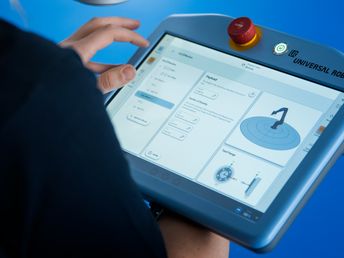
Build Smarter. Deploy Faster. The Software Platform Developers Trust

PolyScope is the software platform that gives you un-paralleled flexibility, access and control to deliver the absolute best experience for your customers.