

Physical AI: Five questions from the factory floor
What does physical AI really mean on the factory floor? Universal Robots’ VP of AI Robotics answers five real-world questions from manufacturers, covering safety, validation, performance, and where physical AI still falls short.
AI Safety & Compliance Product & Technology Industry Insights
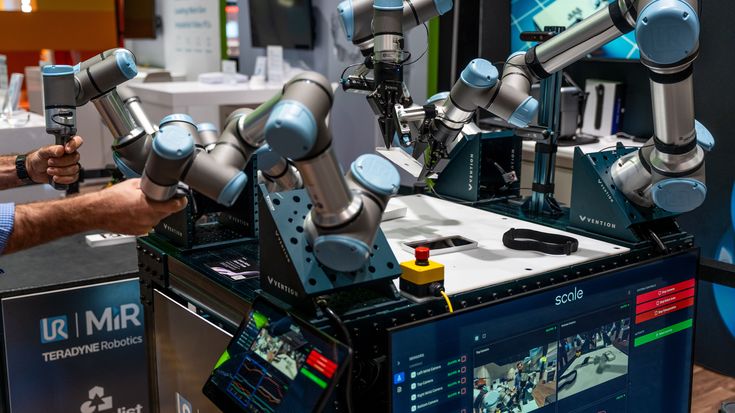
After our physical AI webinar with SICK, NVIDIA, and Inbolt, one thing stood out: The volume and quality of questions coming from manufacturers trying to understand what physical AI really means in production.
To continue the conversation, five of those questions were selected and put directly to Vice President of AI Robotics Products at Universal Robots Anders Billesø Beck. Hear his perspective in the video below, based on current questions and ongoing work with customers and partners.
Anders begins with safety, still one of the biggest hurdles for any new technology. As he puts it, “safety is going to be one of the key stumbling blocks for a lot of technologies to get into the market.” At the same time, he stresses that the fundamentals are familiar. The safety considerations around Physical AI are largely the same as for any other robot application.
Every deployment, AI-driven or not, must start with a proper risk assessment. Universal Robots’ systems include a safety envelope that runs independently of the application itself. This allows manufacturers to define maximum tolerable speeds, configure virtual safety fencing, and constrain behavior at the safety-system level. With those limits in place, “the robot can do all the variation that an AI application will have inside the envelope of safety."
The second question turns to GMP-regulated manufacturing, particularly pharmaceuticals. Anders is direct about the challenge. “There’s no doubt there’s a high degree of need for validation, for certification, and really understanding that there’s a repeatable outcome for your process all the time.”
There is progress, he said, but no shortcuts. There is no readymade cookbook for validating physical AI in regulated environments. Some manufacturers, however, are now “at the cusp of having done statistical validation, statistical analysis on physical AI models.” That work is helping teams prove consistency and define operational envelopes, but it is not straightforward.
Performance and predictability come next. Can physical AI deliver deterministic behavior, including worst-case latency? In many cases, yes, especially when applications are tightly scoped.
“The more we limit the impact of an application where we apply physical AI models, the better the performance and validation is,” Anders explains.
Smaller, task-specific models, such as those for computer vision or tactile control, are already showing strong results. Fully end-to-end AI systems remain cutting-edge and harder to validate over time. Architecture matters. Many AI models run at “somewhere between 10 and 30 hertz,” while industrial robot controllers operate at much higher, deterministic rates. By integrating AI outputs into the robot’s real-time control layers, slower reasoning can be combined with fast, reactive motion, reaching “all the way down to 500 hertz.”
The fourth question looks at existing installations. Physical AI can be used with UR eSeries robots running PolyScope 5, particularly when AI workloads are handled externally and real-time control remains on the robot. At the same time, PolyScope X and the UR Series are designed specifically with physical AI in mind, offering a more integrated foundation going forward.
Finally, Anders addresses where physical AI still struggles. While areas like computer vision and inspection are progressing quickly, challenges remain “where the physics are challenging.” Tasks requiring extreme accuracy, repeatability, or high levels of variation continue to be difficult and remain active areas of development.
Taken together, these five questions offer a grounded snapshot of physical AI today. They show what is working, what is possible, and where the hardest problems still lie.
What are the key safety considerations manufacturers need to address when deploying physical AI on the factory floor?
Safety is going to be one of the key stumbling blocks for a lot of technologies to get into the market. One of the main things manufacturers need to think about is safety when deploying AI is actually quite similar to the needs of safety for other types of applications. The great thing about Universal Robots, is that we have a safety envelope that runs on top of your applications. So you can define maximum tolerable safety speeds, build your virtual safety fencing, etc.
How can physical AI systems be validated and remain compliant in GMP-regulated manufacturing environments?
So for pharmaceutical manufacturing where GMP is the manufacturing practices of how to deploy, it is challenging. There’s no doubt that there’s a high need for validation, for certification and really understanding that there’s a repeatable outcome for your process each time. We talked to a lot of our pharmaceutical partners around this topic and there is progress. There’s no readymade cookbook yet for validating physical AI in regulated environments but some manufacturers are at the cusp of having done statistical validation, statistical analysis on physical AI models.
Can physical AI deliver deterministic, predictable performance, including worst-case latency, and how is that validated?
In many cases, yes, physical AI can deliver these kind of performances. We know that the more we limit the impact of an application where we apply physical AI models, the better the performance and validation. First step is to focus the model on small, specific things. If you think about running a full end-to-end model, I don’t think we’ve reached a point where we can prove that these models with work long-term very consistently. But smaller models like computer vision or tactile control, we’ve seen good results. If you integrate into Universal Robots, we do have the deterministic performance of the robot controller. Many AI models run somewhere between 10 and 30 hertz, the output control for the robot and they may vary. What you get by integrating into some of the UR script layers on the UR robot is a full, real-time, interpolation of the slow outputs of the model down to 500 hertz. So we can get very reactive responses.
Can physical AI technologies be added to existing UR e-Series robots running PolyScope 5 or do they require new systems?
PolyScope X and the new UR Series robots are designed specifically for physical AI. Does that mean you can’t use the older generations of robots? No. But you would need to build a lot of the infrastructure yourself. Inside PolyScope X, you can deploy AI workloads directly on it and send the inference workloads directly on the AI Accelerator for having the NVIDIA Jetson running the AI compute, so it’s a real scalable factory deployment infrastructure. If you know how to do these, if you’re running AI on your own computing cluster or industrial PCs and just remote controlling the robots and leveraging the real-time control layers on the robot, it’s perfectly doable with e-Series robot. We have plenty of e-Series robots in lab doing it well.
Which types of applications are still the hardest to train using physical AI today?
There’s some really great results in end-to-end policies of building complex applications and more delicate like visual inspection and computer vision. Where things are challenging is where the physics are challenging, so it could either be very high accuracy tasks. I think there’s still some active development there. If you want really repetitive, really high accuracy, and even with the dexterity that people have, it’s one of those points where we can move further. Then, variation does remain a challenge. It needs to be taught to the robot systems. And if you have extreme variation, you also need to populate your models in a way where they can handle it.

