

How do you teach robotics for an industry that keeps moving?
Engineering curricula struggle to keep pace with AI-driven automation. A free, university-built curriculum suggests a more durable answer than constant rewriting — and no robot is needed to get going.
AI Industry Insights
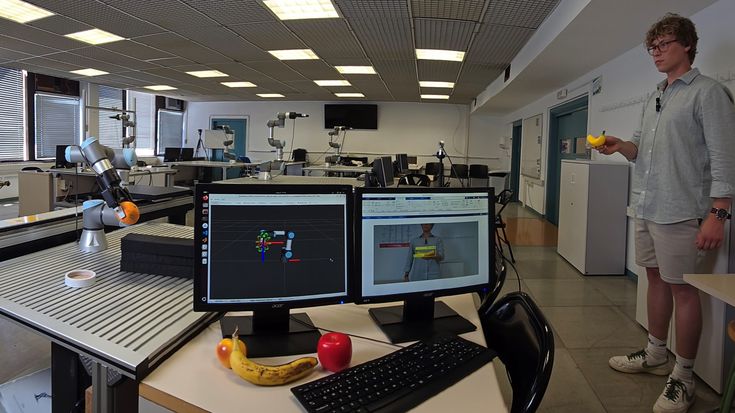
Engineering education may never have been more exciting nor more challenging. The methods that define modern robotics — model-based design, computer vision, reinforcement learning — are changing quickly, and industry is moving toward AI-driven, simulation-first automation. Curricula are not built to change at that speed. Rebuild a course every year to chase the field and you exhaust your faculty; leave it untouched and your graduates arrive in industry already a step behind.
There is a second challenge. Students learn to model and simulate, but fewer get to see whether their work survives contact with a real machine. Simulation can build understanding but hardware builds judgment — the kind that comes from watching a clean model meet an imperfect world. Closing that gap is harder than it should be. Safe, lab-suitable robots are expensive and scarce, and access to them is uneven across institutions and across countries.
Building teaching material that reflects current industrial practice, and keeping it current, is itself a substantial undertaking. The result is that many programs teach the theory of robotics thoroughly while the practice stays just out of reach.
A curriculum built by a university, for universities
From Code to Robot is a robotics curriculum developed by professors and master’s students at the Universitat Politècnica de Catalunya (UPC), with guidance from MathWorks and Universal Robots. One response to the problem above, it is worth the sector’s attention partly for what it is and partly for how it was made. The people who understand a university’s teaching constraints are the people who teach in one. Industry’s role was to keep the material aligned with how robotics is actually engineered today, not to decide what gets taught.
What students work through is a complete engineering workflow, rather than a set of disconnected exercises. They design and model control algorithms in MATLAB and Simulink, validate them in simulation, and, where a program has the hardware, deploy them onto a real collaborative robot. The content spans robotics modelling and control, object detection using computer vision, and task planning with reinforcement learning: the techniques that current automation work increasingly depends on. It is modular, so it fits a full semester or drops into an existing robotics, mechatronics, or controls course as a single unit.
The part that lowers the barrier
The curriculum is free. Lesson guides, exercises, code, and demonstration videos are published openly, and teaching it requires no robot at all — a standard workstation running MATLAB is enough to take students through the full design-and-simulation workflow. Hardware only enters for programs that want students to close the loop physically, and there it is optional, not assumed.
This is the detail with the widest reach. A program with no robotics lab, or a modest one, can still teach current, industry-aligned robotics to a recognized standard. For institutions outside well-funded research centers, and for the many engineering programs weighing what they can afford to offer, removing both the cost of materials and the requirement to own hardware changes what is realistically teachable.
A model, more than a product
The specific curriculum matters less than the arrangement behind it. Universities know what teaching demands; companies know where their fields are heading; neither does the other’s job well alone. A curriculum authored by academics, kept relevant by industry, and given away rather than sold is a reasonable template for how that collaboration can work — and a useful counter to the worry that industry involvement in teaching means industry control of it.
Shared, openly available, current material that takes students from a line of code to a moving robot shortens the distance between engineering education and a rapidly moving field, without asking every faculty to rebuild the same course in parallel.
From Code to Robot is free to access and already available.

