

Testing Agentic Physical AI on UR Cobots
What we tested with the Model Hardware Standard (MHS) research preview — and why PolyScope X is the platform that gets us there.
AI Product & Technology
In brief
- MHS is a new standard, currently in research preview, for AI agents to safely operate physical equipment. With Anthopic we are taking part in the research preview on our own UR cobots.
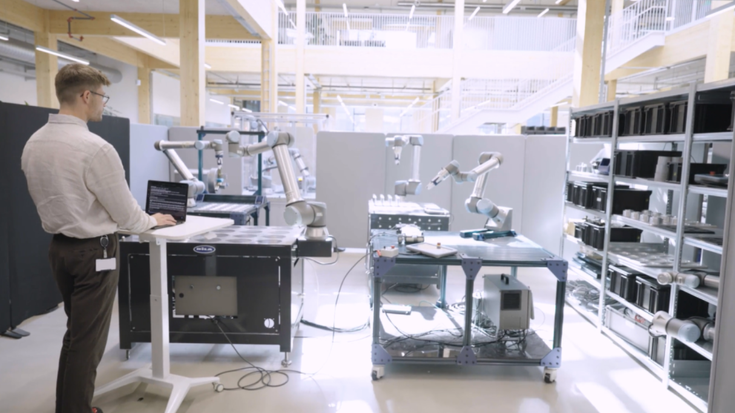
- Given four separate robot applications and plain-language instructions, an agent running on Claude Opus 4.8 coordinated and orchestrated them as a single cell, handing payloads between them.
- Safety is designed into MHS. Devices declare their bounds, interlocks and emergency stops in MHS, and agents inherit and operate within them, while our own safety architecture stays fully in charge underneath. Expressing those bounds in MHS adds a layer on top: the agent can be stopped earlier, or kept from ever reaching the point where the safety system has to act.
- Integration has been the real constraint on automation at scale. This is the strongest evidence we have seen that an agent could eventually shoulder a real part of that work.
- We tested on UR cobots. The same approach should be applicable on autonomous mobile robots (AMRs), which we have not yet tested.
- Note - this is a proof of concept. MHS is not yet generally available.
At Universal Robots, we build human-scale automation: collaborative industrial robots that work alongside people in manufacturing, electronics, and across industry. For decades, the hardest part of that work has not been the robot itself, but rather everything around it — configuring systems, building bridges between the technologies on a factory floor, and orchestrating the many parallel systems that run in a modern plant.
Recently we set out to show how much of that is about to change. The Model Hardware Standard (MHS) is a new standard for AI agents to safely operate physical equipment. It is in a limited research preview, working with Anthropic: the specification is provisional, access is by application, and nothing is generally available yet. Everything that follows took place inside that preview.
The bottleneck we have lived with for decades
Ask anyone who deploys robots for a living and they will tell you the same thing: the challenge is the integration. The expertise it takes to commission a system, build the operator interfaces and connect the PLCs and machines and robots into one working cell. This has been a bottleneck to deploying robots at scale.
Agentic AI will change that equation. With capable models such as Claude, we will eventually be able to explore a system, understand what is really going on inside it, and program, orchestrate, and optimize it at a completely different speed. The kind of iterative workflow we have long taken for granted in software is finally coming to physical automation.
What we tested
In simple terms, MHS lets an AI agent understand a network of devices, browse it, discover the devices on it and what each one can do, and operate them within the bounds each device declares. It is aimed at scientific research and advanced manufacturing.
In the demonstration, we connected an MHS-compatible AI agent — Claude, used via Claude Code — to Universal Robots through PolyScope X. The agent discovered a fleet of four of our cobots live, set them up, and safely operated them working together through MHS.
Nothing was given in advance. There was no complicated hardcoding between the agent and the robots. The agent explored how the system was set up, worked it out, and planned how to operate it within the bounds each device declares. We could even ask it to optimize the flow and improve it as we watched. Seeing this take place on our cobots, at our HQ, was a genuine breakthrough.
PolyScope X: the platform for physical AI
None of this is possible without the right foundation, and that software foundation is PolyScope X.
PolyScope X is our next-generation control system, and it is completely API-first. It was built to be the platform for physical AI — extensible by AI, and designed so that an agent can discover a robot's capabilities and build an application on top of them. MHS then creates the orchestration layer above that, so an agent can coordinate not only our robots but the wider set of devices on a factory floor.
Crucially, that openness never comes at the expense of safety. Industrial systems have hard requirements: stability matters, safety matters, and there are standards we must comply with. You cannot simply let an agent loose on the lowest levels of a machine and hope for the best — you would lose exactly the safety compliance and operator interfaces that make a system fit for a real factory.
PolyScope X lets us combine the power of an agent with the safety technologies we have built over more than a decade. The intelligence sits on top; our safety architecture stays fully in charge. In MHS itself, devices declare their bounds, interlocks and emergency stops in the standard, and agents inherit and operate within them by default. Once it is running at steady state, it runs reliably and deterministically.
MCP for software, MHS for the physical world
There is a good reason this arrives now. Anthropic pioneered MCP, the standard that showed the world how to expose software to AI agents — today many products ship with MCP interfaces. MHS applies that same idea to physical equipment: a common way for agents to discover and safely operate the devices around them.
In this work, Universal Robots, the destination platform for physical AI, provides the robotics, and PolyScope X is where the physical work happens.
What this means for the future of robotics
We expect the time our customers and integrators spend making devices cooperate to drop sharply as agentic AI develops. This in turn means that robotic solutions will reach the factory floor faster and with far less integration risk. It will make robotics much more accessible to manufacturers worldwide, including the smaller producers and high-mix, low-volume lines. A cell that can be re-tasked by describing a new job, rather than reprogrammed from scratch, keeps pace with shorter product cycles.
It also points beyond the single robot. In our demonstration, the agent coordinated four cobots. As agents get better at reasoning across a whole cell, the unit of automation shifts from the individual machine to the system. And the people who build these systems move up the value chain — from writing low-level code to setting goals, supervising outcomes, and handling the cases that call for human judgment. In an industry short of automation expertise, that extends the reach of the engineers we already have.
Teradyne Robotics is the destination platform for physical AI. The most capable AI models need somewhere to act in the physical world, and that place needs real robots – cobots or AMRs - a mature safety story, and a platform open enough to build on. For UR, PolyScope X gives developers and partners that foundation today, and our work with MHS shows what becomes possible.

