Smart I/O

Description

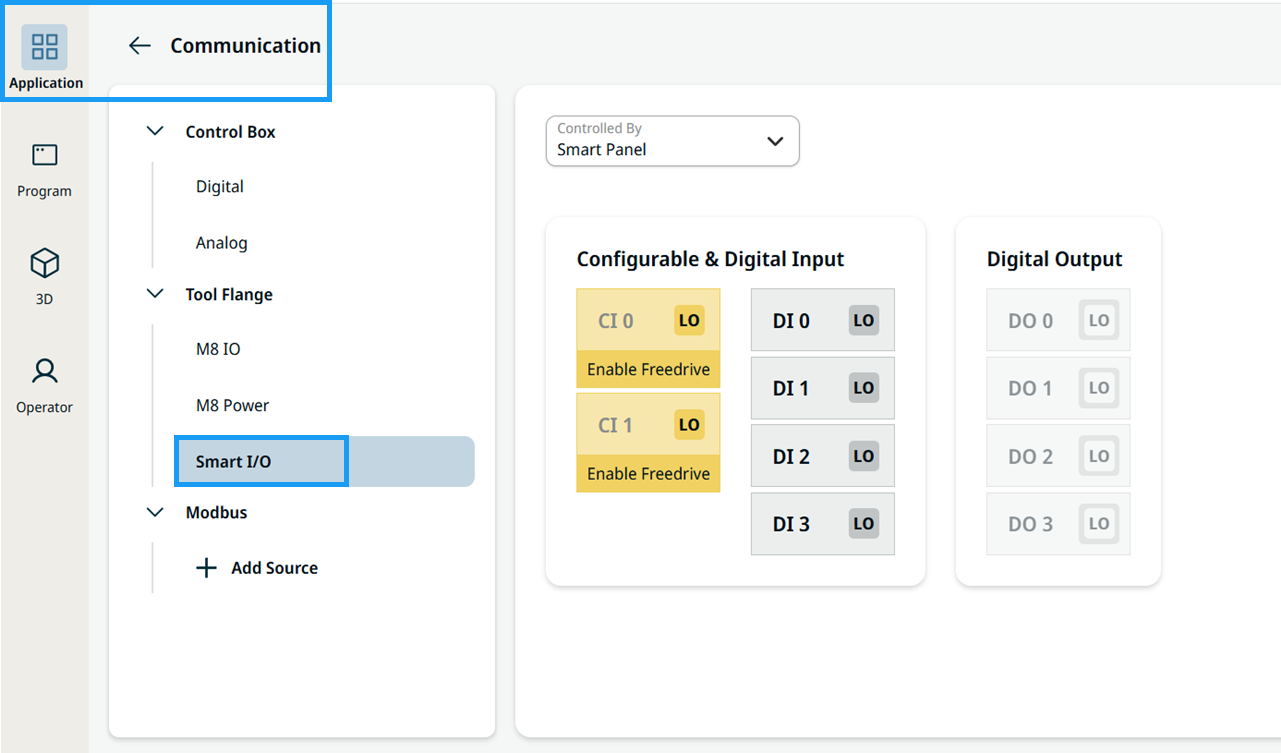
Smart I/O lets you monitor and set the live I/O signals provided on the Performance Tool Flange (PTF). You can find it under the Tool Flange tree on the Communication screen.


Access Smart I/O

  1. On the main navigation, tap Application.

  2. Tap Communication. The screen appears, divided into a left panel and a right panel.

  3. In the Tool Flange tree, tap Smart I/O. The right panel shows the current input and output status in Configurable and Digital Input and Digital Output.


View and rename inputs

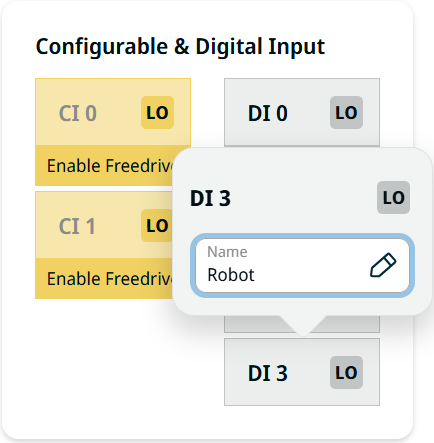
  1. Tap an input (DI 0-DI 3). A pop-up menu appears.

  2. Rename the input, then tap Confirm.


View, toggle, and rename outputs

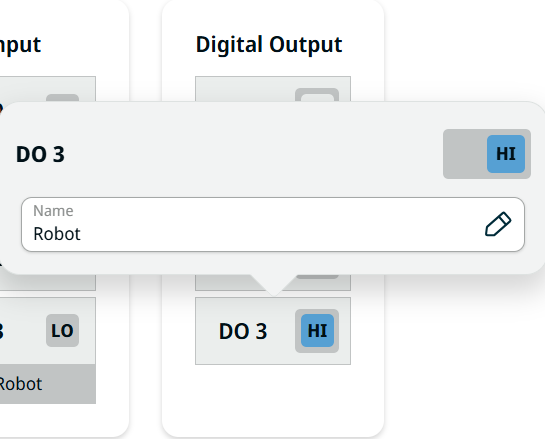
  1. Tap an output (DO) to open a pop-up menu, then rename the output and tap Confirm.

  2. Tap LO/HI to toggle an output.

     
The Smart Panel LED indicator is configured as DO0.


Assign a controller

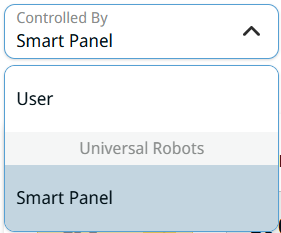
The Controlled By drop-down menu sets the owner of the I/Os, as in tool control.

  1. Tap the Controlled By drop-down menu. The following options are available:

    • Smart Panel

      The default selection. The attached Smart Panel expects to use the I/Os. Triggering an I/O activates a Smart Skill, if one is configured on the Smart Panel page.

    • User

      Disables the Smart Panel. You can toggle the output signals from the Smart I/O page.

    • URCap

      A URCap contribution that registers as a Smart I/O controller appears in the drop-down menu. You can only view the signal values on the Smart I/O page.

  2. Select the owner of the I/Os.

     
When Controlled By is set to User, you can toggle the output signals from the Smart I/O page. When Controlled By is set to a URCap, you can only view the signal values on the Smart I/O page.


Use Smart I/O signals in a program

The Smart I/O signals are available in the Set and Wait nodes of a program tree.