

EV Battery Assembly for Automotive
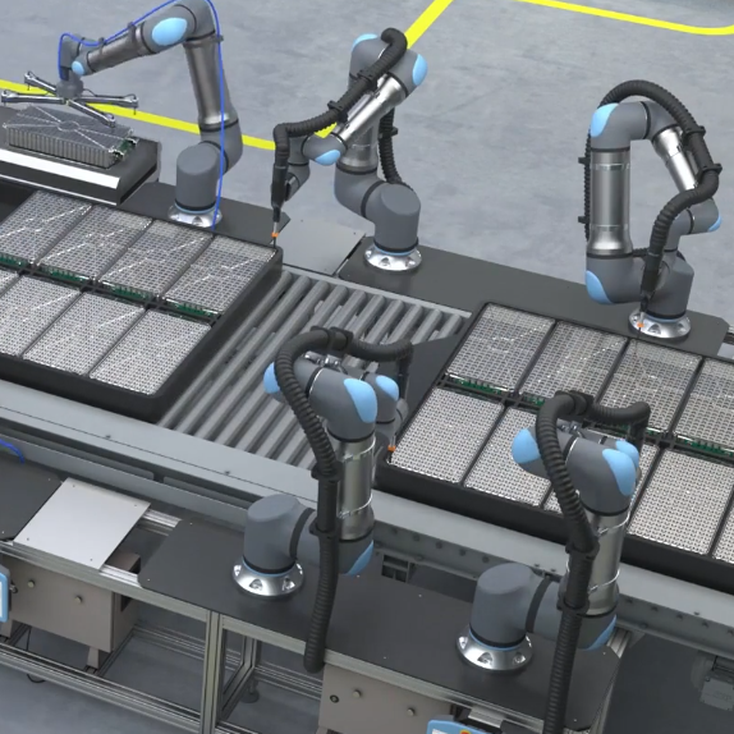
Where EV battery manufacturers face challenges
EV battery assembly requires precise handling of cylindrical, prismatic, and pouch cells, often combined with compression control, electrical isolation, and thermal‑management integration. Manual handling and rigid automation can struggle to maintain consistent positioning and force application as product variants and production volumes increase.
How collaborative robots support EV battery assembly
Collaborative robots apply controlled motion and repeatable positioning across sensitive battery assembly operations. By standardizing how components are handled, aligned, and joined, cobots help reduce process variation while allowing stations to remain adaptable as designs and production requirements change.
Key outcomes include:
- Consistent positioning of cells, modules, and pack components
- Controlled handling of sensitive battery materials
- Reduced process variation across shifts and sites
- Flexible adaptation to new battery designs
- Stable production flow across EV programs
Where Cobots Fit on an EV Battery Assembly Line
Cell handling and kitting
- Pick‑and‑place with orientation control
- Gentle handling of pouch and prismatic cells
- Automated tray loading/unloading
Module assembly
- Screwdriving with full torque traceability
- Busbar placement with controlled seating
- TIM and sealant dispensing with consistent bead geometry
Pack assembly
- Module loading into pack housings
- Connector insertion and cable routing
- Cover installation and fastening
End‑of‑line operations
- Automated loading into testers
- Vision inspection and label application
- Leak test support and fixture handling
Selecting the right robot for EV battery assembly
EV battery assembly requires precise motion control, stable force application, and flexible integration. Collaborative robots are used across battery production where accuracy and adaptability are needed within automotive manufacturing environments.
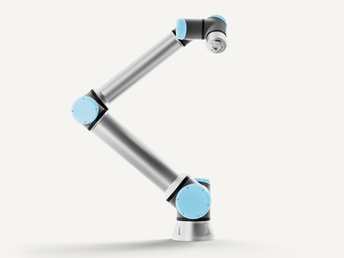
UR12e-1300
- Payload
- 12.5 kg
- Reach
- 1300 mm
New
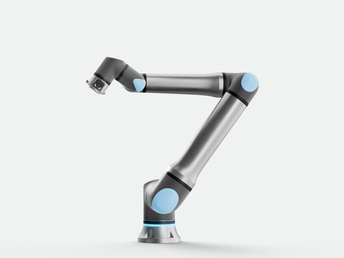
UR17g-1300
- Payload
- 15 kg
- Reach
- 1300 mm
- Extended payload
- 17.5 kg
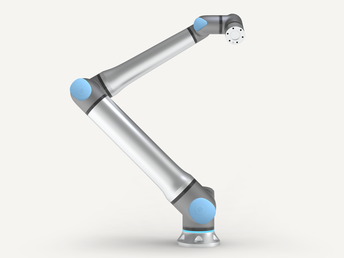
UR20-1750
- Payload
- 20 kg
- Reach
- 1750 mm
- Extended payload
- 25 kg
Additional automotive assembly applications
In addition to EV battery assembly, Teradyne Robotics automates assembly processes across the industry. These applications support a more complete and flexible assembly strategy.
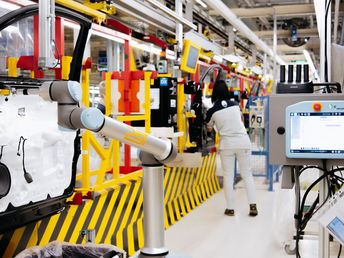
Automotive Assembly Applications
Broad robotic support for automotive assembly tasks, including part handling, positioning, and secondary operations across sub‑assemblies and production lines. Enables flexible automation without disrupting existing processes.
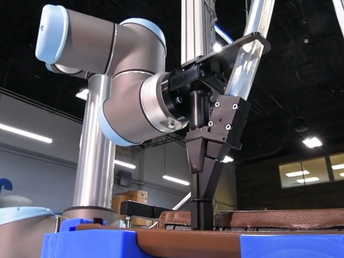
Automotive Clip Insertion
Automated clip insertion for interior and exterior assemblies, improving consistency while reducing part damage and operator strain. Ideal for high‑mix automotive assembly environments.
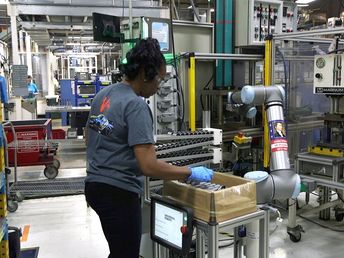
Automotive Press‑Fit Assembly
Robotic press‑fit operations for controlled insertion of bearings, bushings, and precision components. Ensures consistent force, accurate alignment, and repeatable quality in automotive production.
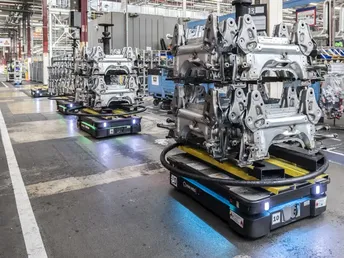
Automotive Parts Transportation
Automotive manufacturing relies on a continuous flow of materials. Components, kits, and containers need to reach the correct station precisely when required to ensure takt time and stable production.
Talk to an automotive automation expert
An automotive automation specialist will follow up to discuss your application and production requirements. The goal is to understand your setup and explore practical automation options, no commitment required.
