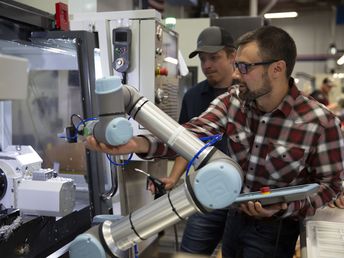
Tool Craft in Seattle, Washington, is a small machine shop that manufactures parts for the aerospace, medical, and defense industries.
When a larger order required the company to run production 24/7 by adding a third shift, Tool Craft faced a challenge. Hiring for a third shift was extremely difficult, as few people were interested in working those hours. With unemployment at around three percent, job postings received very few responses.
As a result, the company decided to look at automation and chose a collaborative robot. The idea of machinists working alongside the robot was very appealing, especially because it eliminated the need for a safety cage, unlike traditional industrial robots.
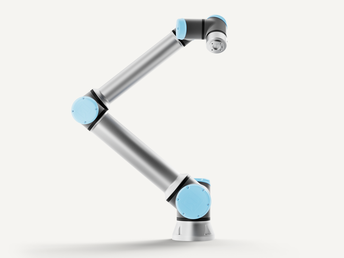
When selecting a robot for CNC machine tending, precision is always a critical factor. When the new e‑Series was announced and it was confirmed that the UR5 had a repeatability of 30 microns, the team was very excited. This level of precision competes directly with traditional industrial robots.
The new e‑Series robot behaves much like a human operator because it has force feedback in all joints. This allows the robot to force a part into a very tight, precise locating fixture, wiggle it into place, and apply programmable compliance — effectively giving the robot a human touch.
One of the immediate benefits was increased production. The company was able to staff the third shift and increase output from 255 parts per week to 370 parts per week.
In addition, the team was able to complete a year’s production seven weeks earlier than planned. This freed up the machine to work on other jobs and improved overall capacity.
Costs were also reduced by 23 percent, allowing Tool Craft to be more competitive on long‑term projects.
For this application, the company selected a New Kinetic pneumatic gripper. A key factor in this decision was that the gripper is UR+ certified, meaning it is guaranteed to work with Universal Robots straight out of the box.
An integrator helped get the first job running and worked closely with Tool Craft’s manufacturing engineer, Brian Lopes. After only one or two hours, Brian was able to take over the programming independently.
Brian also completed training through the Universal Robots Academy. The combination of the UR Academy and on‑site training enabled Tool Craft to expand the cobot application without external support, including adding a rinsing station to the cycle.
The ability to program offline was another major advantage. Initially, the team expected production downtime during programming, but offline programming allowed the system to be set up without interrupting operations.
With one successful installation completed, Tool Craft is confident about future automation plans. The company expects to install one robot per year moving forward.
Having in‑house expertise is critical. Brian can troubleshoot issues and quickly restore production whenever needed.
The next application under consideration is using a robot to tend a horizontal milling machine, and the team believes they are well prepared to take on this challenge.