
<link rel="stylesheet" href="app_assets/styles-R77XALWP.css"> Skip to main content
Robotics in electronics manufacturingRobotics in electronics manufacturing

Robotics in electronics manufacturing: a practical guide

Your line is automated. The work around it often isn’t. 

This guide is for EMS providers and electronics OEMs who want to take the next step in automation: the handling, assembly, testing and cable work that depends on skilled hands. It explains where cobots are working today, what it takes to start, and where the technology is heading, with examples from manufacturers who have done it.

Where your line stops being automated

Inside the SMT line, machines print, place, solder and inspect. Once your step and the picture changes: people load test and programming stations, drive screws, fit modules, route cables and pack boards.

That’s not because the electronics industry avoids automation. In fact, it’s the largest segment for robotics, with new installations in 2025 making up 24% of the world total, according to International Federation of Robotics. Most of these robots, though, run fast, fixed, high-volume tasks. The work around the line changes more often, runs at lower volume or needs a careful touch, and that’s where industrial cobots fit.

Why robotics in electronics matters now

Three pressures are pushing automation beyond the SMT line:

Consistency. A defect costs more the further it travels: a mis-loaded board or a loose screw caught at the station is cheap: found in test, it’s rework, and when found in the field, it’s a return and a customer problem. Manual handling and inspection vary across a shift, as fatigue sets in. A cobot does the last cycle of a shift the way it did the first.

Staffing. The jobs around the line, such as loading, packing, screwdriving and inspecting, are repetitive and often hard to staff. Automating these tasks frees skilled people for higher-value work that demands human judgement.

Product mix. EMS providers juggle many customers, with frequent product changeover. As a result, automation must change with them, so cells that be reprogrammed and moved rather than rebuilt are favored.

How Flex automates across its global manufacturing footprint

Flex, a global leader in electronic manufacturing services, has built a standardized automation platform deployed across its worldwide facilities, serving customers in automotive, industrial, healthcare, lifestyle, communications, enterprise and cloud markets. The platform uses collaborative industrial robots and AMRs to automate “difficult, tedious and precision tasks” whenever needed.

During the development cycle, the Flex Automation team researched and tested several cobots for us in the integration of its platform. Teradyne Robotics has become one of our strategic automation partners, and we are now deploying these solutions across Flex facilities.

During the development cycle, the Flex Automation team researched and tested several cobots for us in the integration of its platform. Teradyne Robotics has become one of our strategic automation partners, and we are now deploying these solutions across Flex facilities.

Where cobots work around the electronics line

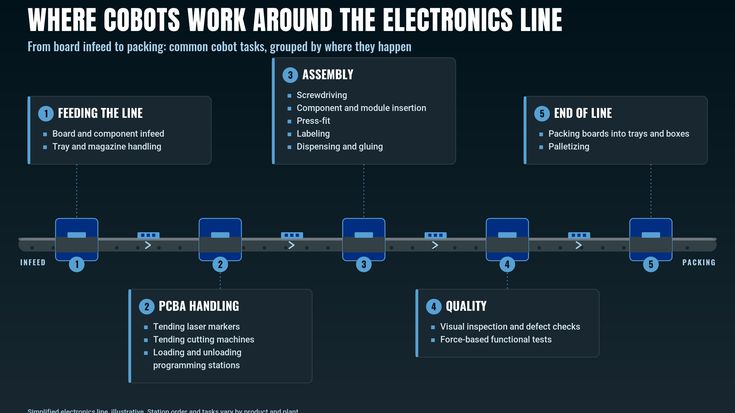
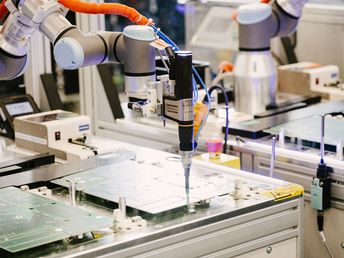
Cobots show up at many points around an electronics line. The map below groups the most common tasks by where they happen.

Where cobots work around the electronics line

Dive deep with our application guides

PCBA handling guide

PCBA handling guide

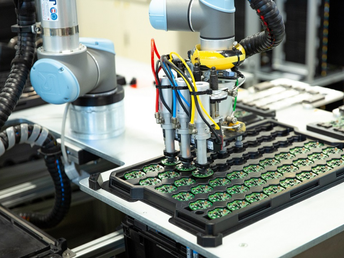
This guide looks closely at two of those jobs, station loading and end-of-line packing, through manufacturers that handed them to Universal Robots cobots.

Assembly guide

Assembly guide

This guide looks at two of them in depth, screwdriving and insertion, shows how electronics manufacturers handed them to cobots, and helps you judge which of your steps are ready.

How manufacturers usually start

Most electronics manufacturers begin with one well-defined task and expand from there. A common path:

  1. Inspection. Consistent checks on every unit; low disruption and easy to measure.
  2. Station loading and unloading. Keeping tests, programming and marking stations running.
  3. Insertion and assembly. Screwdriving, component fitting and module assembly.
  4. Expansion. More cells and stations as results come in.

The pattern shows in the examples: Siemens’ Erlangen plant started with one cobot in 2017 and now runs more than 70, and YUEYIN added four cobots across three stations.

Cobots

Planning a cobot cell in electronics

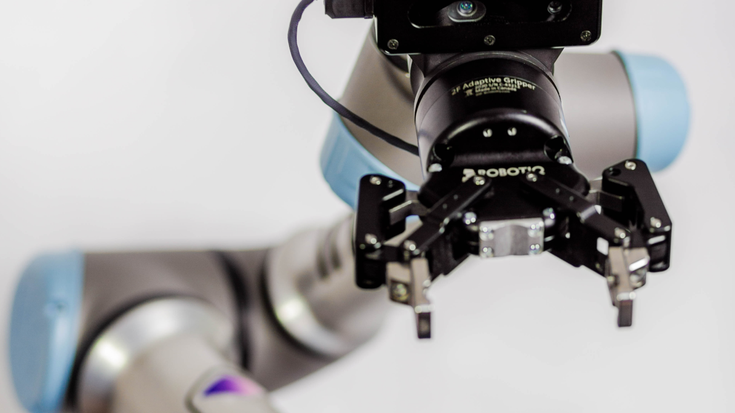
A few decisions shape most electronics projects early. First, the tool: boards, modules, screws and connectors each need the right gripper, often from a UR partner. Second, how parts arrive: trays, stacks and fixtures keep a cell simple, while mixed parts need vision. Then there’s how the cell connects to the station it tends and to your MES or traceability systems, which often decides whether a pilot becomes a rollout.
Vision guided with AI

Where AI comes in.

Vision is often where AI enters the picture. Finding parts and guiding the robot to them is already established in industry. Vision technology has developed rapidly. AI-guided cable routing and connector insertions has so far been shown in benchmarks and demonstrations.

The broader shift is toward robots that learn tasks rather than follow programmed paths. Flex is one provider moving the same way: “We are working closely with partners like Teradyne Robotics on use cases where physical AI can be applied within complex assembly cells.”

Where to start on your line

Answer these questions first:

  1. Where does your line stop being automated?
  2. Which steps are repetitive and hard to staff, especially on night shifts?
  3. How is inspection done today, and what escapes to test or the field?
  4. Who loads and unloads your test, programming and marking stations?
  5. How often do you change over for a new product or revision?
  6. Which step would you measure first, and how?

Then pick the guide that matches your answers or talk it through with us.

Talk it through with us

Bring your answers to a Universal Robots EMS expert. They will help you pick a first step, show you what manufacturers like yours have done, and connect you with a UR partner or integrator near you.