The history of Bob’s Red Mill began in 1978 with Bob and Charlee Moore. They were looking for healthier ways of eating and wanted to make sure everyone had access to wholesome food.
Our purpose is to inspire joy with wholesome foods, whether that’s breakfast cereals, flours, or baking products. Bob’s Red Mill has a vision to double the number of people eating Bob’s Red Mill products by 2030, and automation helps us move toward that goal.
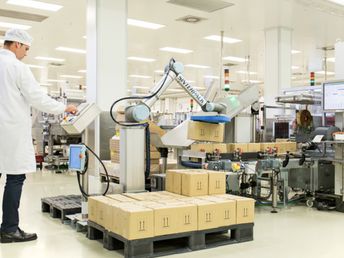
One of the reasons we looked into collaborative robots was our desire to bring more automation to the production floor. Collaborative automation fits well in the space between traditional industrial robots and manual palletizing, allowing for a smaller footprint while still using floor space efficiently.
We like Universal Robots because of their simplicity and the modular, out‑of‑the‑box features they offer.
[Music]
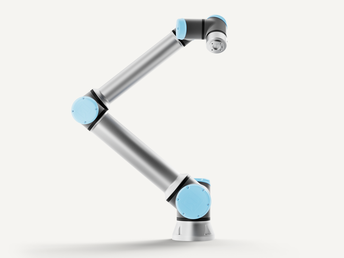
The UR20 adds additional payload capacity, which allows us to double‑pick cases in order to meet production rates.
Our pallets are roughly 81 inches tall. The UR20’s reach eliminates the need for a seventh axis, so we don’t have to elevate the robot arm. That helps maintain our production rate and allows the robot to move into position much more quickly.
[Music]
Columbia was very excited to get the UR20. We had already prepared our solution, with a palletizing cell pre‑engineered and ready for the robot arm. Once the arm arrived, it was very easy to incorporate and set up.
[Music]
We unboxed and implemented the UR20 into our solution in about a day and a half. Training with the Mini Pal+ and the UR20 is quite simple. Using the teach pendant, operators only need to learn a few basics around operation and pattern design, and the process is very seamless.
Compared to traditional industrial robots, the UR20 implementation is much quicker.
[Music]
When I first saw the UR20, I was surprised by its size — it’s a big robot — and that added a lot of confidence. The training is well thought out and fairly easy. Anyone at the operator level can learn how to operate a Universal Robot.
We were able to train all four shifts of the maintenance team in roughly 45 minutes to an hour, covering multiple scenarios.
We do a lot of changeovers today. We package powders as well as granular products, and we anticipate hundreds of different changeovers over time. With a palletizer system like this, those changeovers are much easier to manage.
Employees at Bob’s Red Mill are really excited to see this palletizing technology come to the production line. As an employee‑owned company, automation helps us grow the business, share profits through profit‑sharing, reduce injuries, and ensure everyone goes home safely.
[Music]
With automation in place, employees can now focus on more value‑added tasks instead of repetitive or monotonous work.