

Robots in cell therapy? How Universal Robots is rewriting the rules
Multiply Labs, leveraging Universal Robots' collaborative robots, has developed a groundbreaking robotic cluster that is fundamentally transforming the manufacturing of life-saving cell and gene therapies. The Multiply Labs solution drives a staggering 74% cost reduction and enables up to 100x more patient doses per square foot of cleanroom.
It is shocking to see how manual pharmaceutical manufacturing still is. Everything is done by hand by highly skilled scientists. I immediately thought, robots can really help here.
Cell therapies are a new type of drug and typically cost between $300,000 and $2 million per dose, per patient. The way it works is that the patient’s own blood is used to manufacture the therapy.
However, this process is very expensive because each dose must be manufactured specifically for an individual patient. It’s not scalable enough to provide treatment to everyone who needs it.
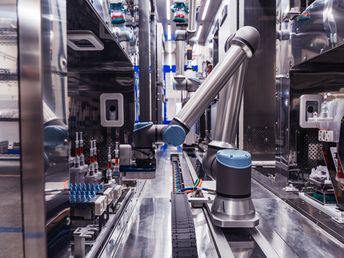
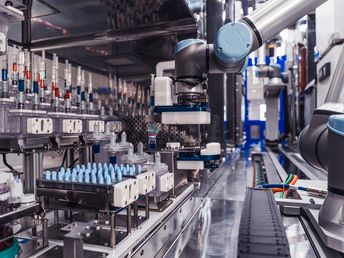
In our robotic system, we have up to four separate Universal Robots arms working in parallel—two on the floor and two mounted on the ceiling, positioned literally on top of each other.
When we compared robotic manufacturing to traditional manual processes, we found a cost reduction of about 74 percent.
This reduction is extremely important because it enables us to lower the manufacturing cost of cell therapies and distribute production across multiple locations in North America and around the world.
Clean room space is extremely expensive. In our estimates, robotic automation allows up to 100 times more patient doses per square foot of clean room space. That represents a complete transformation in productivity for pharmaceutical companies.
We also observed significant improvements in quality and consistency. Robots reduce variation and increase standardization.
Another major advantage is sterility. Robots don’t breathe, so they aren’t introducing contaminants into the environment. They also don’t accidentally touch things they aren’t supposed to.
Regulatory agencies value improvements in quality. With robotic systems, track-and-trace becomes far more reliable. There’s no risk of mixing up one patient’s cell therapy with another’s. That difference can mean life or death.
Much of our technology is based on imitation learning. We work with pharmaceutical customers who provide video demonstrations of their processes. Our robotic systems then learn to replicate those actions.
There is often one scientist who consistently achieves the highest yield. We use that expert’s technique to train the robots.
The robots then repeat those best practices consistently and within very tight performance limits. That level of repeatability is the key to scaling production.
One major advantage of the Multiply Labs robotic cluster is that the robots use the exact same process and equipment as human operators.
This is critical because if a pharmaceutical company already has an approved product, it cannot easily change the manufacturing process.
Using robots without altering the process can save years of regulatory review and hundreds of millions of dollars. Instead of going back to regulators to approve a completely new manufacturing method, companies can say: this is the same process, simply executed by a robot.
In the end, this will increase patient access to potentially life-saving therapies.
We love building robots. We might as well build robots that help people.
Learn more
Case Story
Multiply Labs
Multiply Labs leverages UR cobots to transform the manufacturing of life-saving cell and gene therapies, cutting costs by 74% and enabling 100x more patient doses per square foot. Their system also improves quality, sterility and repeatability through precise, cleanroom-ready automation.
Blog
Robotics transforms cell therapy: Multiply Labs drives staggering 74% cost reduction, unlocking global patient access
Breakthrough partnership with Universal Robots transforms "artisanal" manufacturing, making personalized, life-saving cancer treatments affordable and widely available.
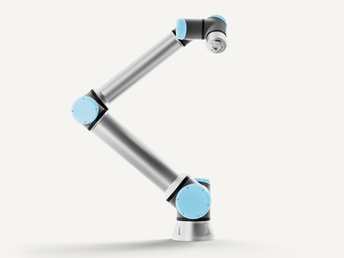
UR12e-1300
12.5 kg payload, 1300 mm reach, powered by CB7 controllers
- Payload
- 12.5 kg
- Reach
- 1300 mm
