

Ease of Programming Extends Cobot Use after Drop in Customer Order
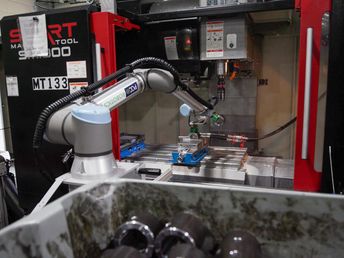
Watch how the WST Fab team in Wisconsin worked closely with Universal Robots Certified Systems Integrator, PCC Robotics, to plan for the complete machine tending system. The cell includes the UR10e cobot, end-of-arm tooling, system base, staging for raw materials and finished parts, as well as full integration with the CNC machine. Upon delivery, PCC Robotics ensured that each customer is fully trained, using both the online UR Academy modules as well as onsite instruction. Training that enabled WST Fab to quickly pivot when a big order fell through.
We had a family of parts — six parts — and we were running a lot of them every year. Then, all of a sudden, that work dropped off the following week. It was a bit of a panic. We didn’t know what we were going to do with the system and started asking ourselves what else we could put on it, since it was capable of doing so much.
Probably two days later, I started looking at different grippers. Changing grippers was easy, and we already had a 3D printer, so we began looking at what we could change with the fixturing. The setup was so universal that we only needed to change a few things here and there, and then we were off to the races.
When you first start working with a UR robot, you look at the teach pendant and, if you don’t know anything about it, it can be a little intimidating. But once you start playing with it, it becomes very easy to learn.
I’ve already trained two other people to do basic setups. I’m confident that if I went back to them now, they could create simple programs and get running on their own, just like I did. It’s amazingly simple and easy to work with.
In the two months since the robot arrived, we’ve probably run about twelve different parts on it. Some were large orders, some were small, but everything is set up so easily that we can put a job back on the machine within an hour and be up and running again.
Working with PCC was a great experience. We made a plan, communicated throughout the entire process, and they helped us wire everything up. We spent several evenings on the phone with their engineering team, sometimes as late as eight o’clock at night, working through small problems or hiccups.
Instead of pulling my hair out all night, we figured things out and were back up and running again. I would absolutely do it again in a heartbeat.
We make sure that parts that are well suited for the cobot are routed to that machine. Tyler is probably running the 3D printer every week so we can make different grippers to adjust for outside diameters, whether the parts are round, square, or something else.
We also work closely with our scheduling department to identify which parts are cobot‑centric so we can ensure they are routed to the right machine. Once we have a few repetitive parts running, we’re always pushing to find more parts and new ways to use the system.
We regularly discuss what else we can automate. We ask whether we can use a cobot on the press brake, on a turning center, or identify where the next best application might be.
It wasn’t great news to get a phone call from a customer saying their own customer had pulled the rug out from under them. But seeing how Tyler pivoted in that first week — not only reacting quickly but then building on that momentum over the following months — was impressive.
He executed a wide range of geometries, developed different workholding solutions and gripper fingers, and even redesigned a staging solution on the fly. That’s how it should work every time. Does it always happen that way? Of course not. But it’s a testament to how we’ve designed our business and to the Universal Robots programming environment.
Learn more
Case Story
WST Fab
The cobot has addressed labor issues around undesirable, repetitive, and unergonomic machine tending tasks.
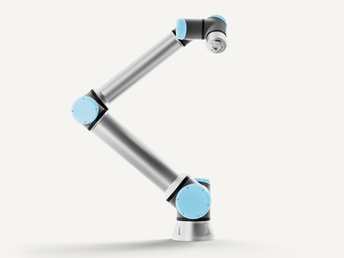
UR12e-1300
12.5 kg payload, 1300 mm reach, powered by CB7 controllers
- Payload
- 12.5 kg
- Reach
- 1300 mm

Blog
Common Robotic Machine Tending Applications
Machine tending – the loading and unloading of manufacturing machinery – has historically been one of the most common applications of industrial robots.
