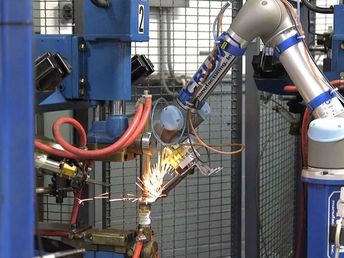
THG Automation is a welding and cutting robotics provider. We serve customers who normally wouldn’t have invested in traditional automation systems for their manufacturing operations.
We’re a Universal Robots partner. We have a great relationship with them and really value their platform. That’s where we provide the capabilities for the robot to execute welding operations.
Coordinated motion takes a six-axis robot and allows it to add additional external axes, enabling part manipulation while the robot synchronizes with those axes. The timing is coordinated within milliseconds.
This allows us to perform welds that previously weren’t possible. In the past, you might have had to rotate a part, stop welding, reposition it, and then resume welding. With coordinated motion, we can perform those operations seamlessly.
We have dozens of customers interested in this capability. For example, if a customer wants to perform hard-facing on ductwork with complex shapes, they can now do that. If they want to weld helical shapes such as screws, augers, or centrifuges, they can now accomplish that thanks to coordinated motion functionality.
Universal Robots provided the core functionality through their program interface, and we built a user interface on top of that. This allows customers to use what they’re already familiar with while adding powerful new functionality.
They can now maintain the welding process while rotating the part, eliminating non-value-added operations. We always say, “When you’re throwing sparks, you’re making money. When you’re not welding, you’re not making money.”
If they can move the part and continue welding—rather than stopping, rotating the part, and restarting—they eliminate downtime. The same applies to cutting operations. Instead of stopping to reposition the part for reach, they can continue the cutting process uninterrupted.
These are all value-added improvements that weren’t possible before. The impact on productivity and the bottom line is significant. I can easily see double-digit improvements in system productivity.
This will open up many doors. Traditional automation platforms are often complex and difficult to use. Some customers may have tried automation before and failed because it was too complicated.
We believe that coordinated motion, the MotionPlus package provided by Universal Robots, combined with our software, will be a real game changer in the industry.
Starting with single-axis coordinated motion introduces customers—especially those new to robotic automation—to an accessible entry point. From there, they can move into multi-axis coordinated motion, where tracks and rotational positioners work together with the robot simultaneously.
I think customers will be amazed at how useful and powerful this functionality is.
Working with Universal Robots on MotionPlus has been a true collaboration. They’ve worked closely with us, providing software updates so we could develop our portion of the solution. We’ve also shared feedback from a development standpoint.
It reminds me of my early days working with traditional industrial robots. This feels like traditional industrial robotics—version 2.0.