Operating Space
| Description |
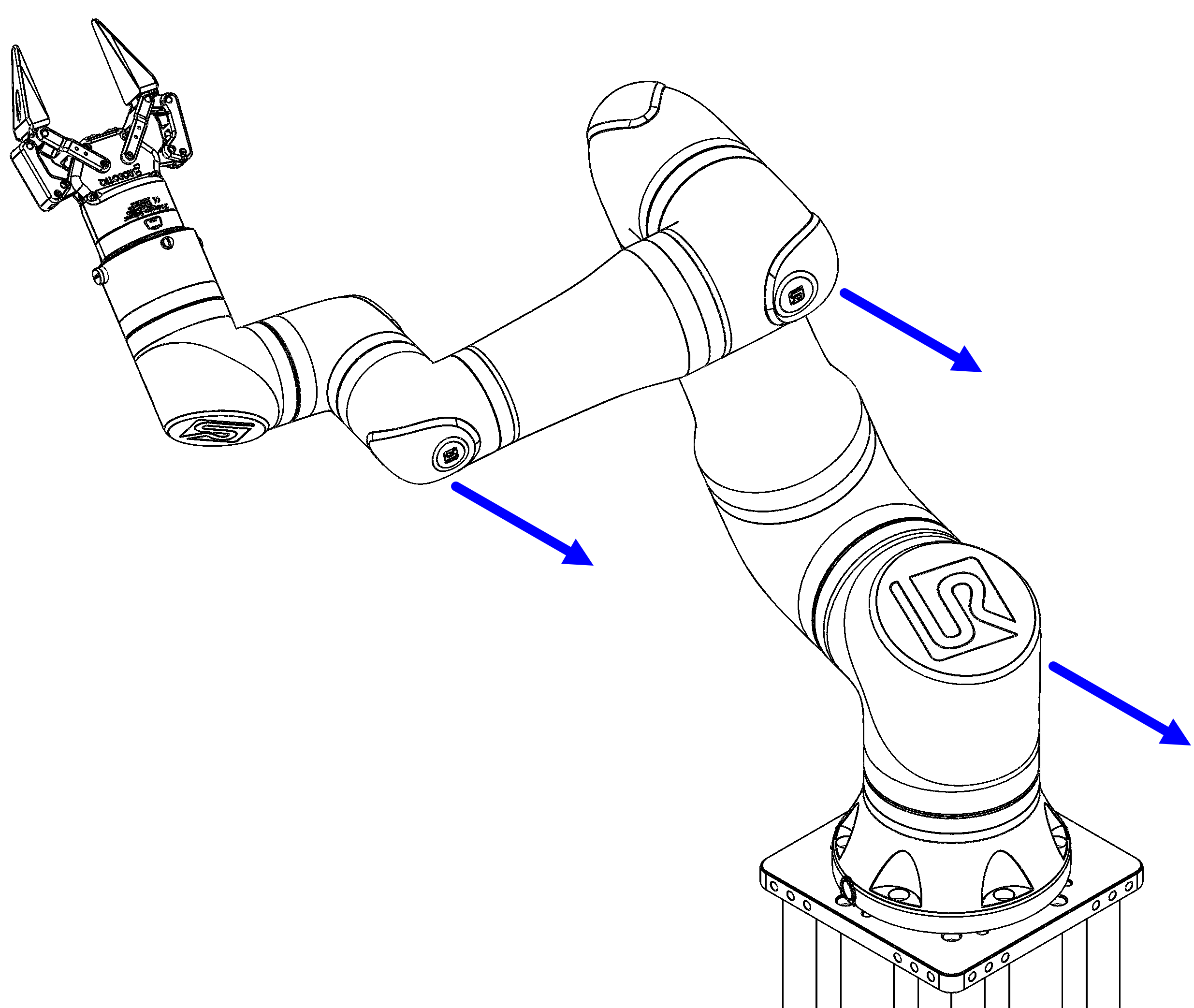
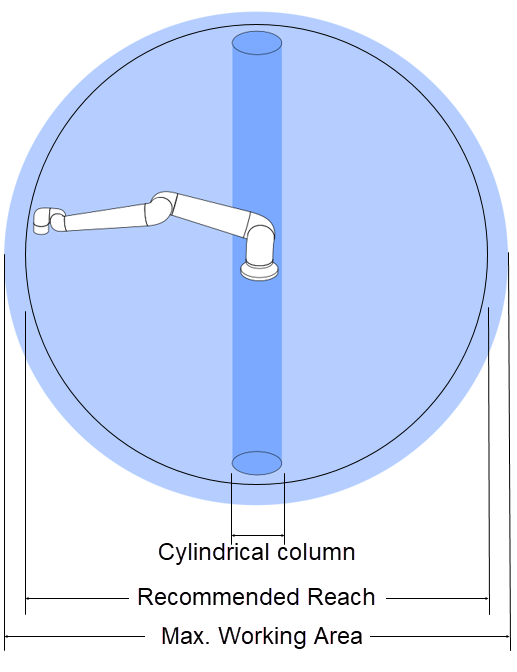
The workspace is the range of the fully extended robot arm, horizontally and vertically. The operating space is the location where the robot is expected to function. The robot workspace is spherical. In the Recommended Reach sphere, the robot can move the tool to any position with almost any orientation. The area outside the recommended reach is the Max Working Area. In this sphere, most positions can be reached but with restrictions on the tool orientation, because the robot physically cannot reach far enough in some situations. In the center of the workspace, directly above and below the base joint, there is a cylindrical column with movement restrictions.
It is important to consider the cylindrical column when choosing a location to mount the robot. Moving the tool close to the cylindrical column should be avoided because it causes the joints to move fast even when the tool is moving slowly. This can cause the robot to work inefficiently and can make it difficult to conduct a risk assessment. |
|
The power plug for the mains connection shall be placed outside the reach of the robot, such that power can be removed without exposing personnel to potential hazards. Disregard for the robot workspace and operating space can result in damage to property. Moving the tool close to the cylindrical volume can cause the joints to move too fast, leading to loss of functionality and damage to property.
|
| Singularity |
A singularity is a pose that restricts the motion and the ability to position the robot. The robot arm can stop moving or have very sudden and fast movements when approaching and leaving a singularity. During placement of the robot in the workspace and definition of the operating space, it is important to take into consideration the singularity position.
The following cause singularity in the robot arm:
|
|
Make sure robot motion near a singularity does not create hazards to anyone within the range of the robot arm, end effector, and workpiece.
|
| Outer workspace limit
|
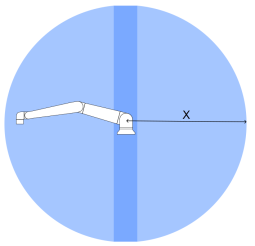
The singularity occurs because the robot cannot reach far enough or it reaches outside of the maximum working area.
To avoid: Arrange the equipment around the robot to avoid it reaching outside of the recommended workspace. See Technical Specifications Robot Arm (g-Series).
|
| Inner workspace limit
|
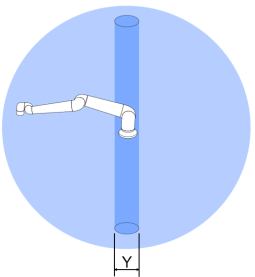
The singularity occurs because the movements are directly above or directly below the robot base. This causes many positions/orientations to be unreachable.
To avoid: Program the robot task in such a way that it is not necessary to work in or close to the central cylinder. You can also consider mounting the robot base on a vertical surface to rotate the central cylinder from a vertical to horizontal orientation, potentially moving it away from the critical areas of the task. See Technical Specifications Robot Arm (g-Series). |
| Wrist alignment
|
This singularity occurs because wrist joint 2 rotates on the same plane as the shoulder, elbow, and wrist joint 1. This limits the range of movement of the robot arm, regardless of workspace.
To avoid: Lay out the robot task in such a way that it is not necessary to align the robot wrist joints in this manner. You can also offset the direction of the tool, so that the tool can point horizontally without the problematic wrist alignment.
|