<link rel="stylesheet" href="app_assets/styles-R77XALWP.css"> Skip to main content

PCBA handling: station loading and board packing

Most of an SMT line already runs without hands.

Packaging

The work around it often doesn’t. Someone still puts boards into marking, cutting, programming and test machines, takes them out again and packs them for shipment. It’s also where most industrial robots end up: IFR 2026 counts 52% of the 603,307 industrial robots installed worldwide in 2025 in handling operations.

This guide looks closely at two of those jobs, station loading and end-of-line packing, through manufacturers that handed them to Universal Robots cobots. It ends with a checklist to help you judge whether the same would work on your line.

Application 1: Loading process and test stations

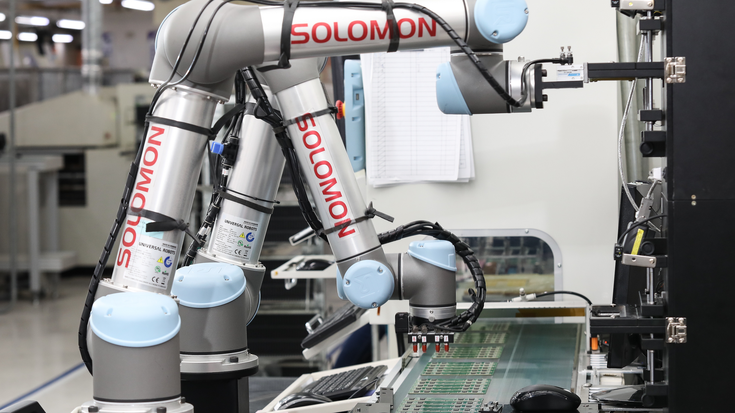
The station itself, whether it’s a laser marker, a cutting machine, a programmer or an electrical tester, already does its job automatically. What’s manual is the time around it: picking the board, placing it correctly, starting the cycle, removing it and passing it on. A cobot takes over that work and leaves the station as it is.

YUEYIN Technology added cobots instead of replacing machines

YUEYIN Technology, an electronics component maker in Taiwan, relied on custom-built production machines. Then orders shifted to smaller, more varied batches, and those machines started outliving their usefulness.

Rather than replace them, YUEYIN added four UR5 cobots at three existing stations on its memory module line:

  • Laser marking. The cobot places the PCB in a semi-automatic laser marker and checks that it’s seated before the cycle starts. Afterwards, it uses vision to confirm the serial number, model number, and trademark were marked correctly.
  • PCB cutting. The cobot loads and unloads a semi-automatic cutting machine and swaps in a new tray when the current one is full.
  • SPD auto burning. Two UR5 cobots share the station: one feeds material into the machine, while the other places finished boards in a tray.

YUEYIN reported an average return on investment of eight to nine months per robot, and the company says 90% of the equipment can be reused for new production when a product reaches the end of its life cycle. Adding cobots also removed staff from laser exposure, glass-fiber dust and repetitive hand movements.

What it shows: The machines stayed, while the hand-offs changed, keeping existing equipment useful as products changed.

Read more

Schneider Electric tends a test station

The same approach also covers the step after PCBA, once boards are built into finished devices. At its plant near Brussels, Schneider Electric uses a UR5e to pick modular DIN-rail switches, load them into a machine, then unload and place on a laser marking station.

What it shows: a cobot can load a test station every 10 seconds and handle parts of varying sizes without changing the line. A local integrator can deliver the cell in months.

Read more

Application 2: Packing finished boards at line speed

At the end of the SMT line, finished boards go into trays or blisters for final assembly, either at the customer’s site or in another part of the plant. The work is monotonous, multi-shift work, and a cobot only fits if it can keep pace with the line's cycle time.

Melecs EWS

Melecs EWS packs 2 million boards a year with one cobot

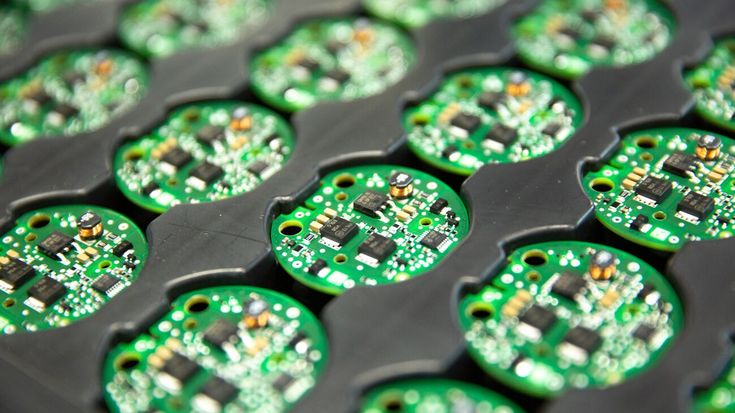
Melecs EWS, an Austrian electronics manufacturing service provider, wanted to automate faster and at lower cost than conventional systems allowed. With Fraunhofer Austria Research, it picked a pilot: packing small round PCBs for vehicle water pumps, a job previously done by hand in three shifts.

The hard requirement was speed.

The greatest challenge was to meet the very short cycle times of five to six seconds packaging time per module

Titanilla Komenda, the Fraunhofer Austria Research robotics engineer in charge of developing the system.

The team met it with one UR5 and one tool doing several jobs at once:

  1. After depaneling, an operator places a group of boards in the cobot’s work area.
  2. The cobot scans three boards with laser scanners.
  3. Three flow grippers pick one board each and place all three in a tray at the same time.
  4. When the 54-board tray is full, a vacuum gripper on the same tool packs it into a box.
  5. When the box is full, the vacuum gripper closes the lid.

Melecs reports a 25% productivity increase in the work cell and expects the cobot to pay for itself within 18 months.

“The UR robot packs around two million components a year without errors.” - Komenda

YUEYIN’s cutting station shows a smaller version of the same idea: the cobot swaps in an empty tray when the current one is full, so the station keeps running.

What it shows: one UR5 took over a three-shift operation and kept pace with a five-to-six-second cycle. Fitted with a single multi-function tool, it fills trays, packs boxes and closes lids, packing ~ two million boards a year without errors.

Read more

High mix can be a good opportunity

Many variants and frequent changeovers are normal in EMS, but high mix doesn’t always mean low volume. Customers may run a mix of products, with a few that also run at high volume. Full automation tends to be all or nothing, and a cobot can fill that gap: it can take the high-volume boards while operators handle the low-volume variants.

That split could also help mid-size plants that struggle to staff a night shift. Operators could work the varied, low-volume jobs during the day and leave the high-volume boards to the cobot overnight.

The wider market points the same way. IFR 2026 describes a shift from robots built for high-volume, low-mix work toward adaptive systems that can operate in changing production.

Packaging

Is your handling step a good candidate?

Answer these about one station or packing step on your line:

  • How do boards arrive: in a conveyor, a tray, a stack, a panel or depanelized?

  • How many board variants pass through this step, and how often do you change over?

  • What cycle time per board does the step need?

  • Is the station semi-automatic with a start signal, or fully manual?

  • How do you confirm the right board went into the right place today?

  • How many shifts does the step run, and how many people does it take?

  • Do a few of those variants run in high volume, or on a shift you struggle to staff?

Steps with consistent presentation, an existing machine to tend and a clear cycle time make the strongest first candidates.