<link rel="stylesheet" href="app_assets/styles-R77XALWP.css"> Skip to main content

Assembly, insertion and screwdriving

Screwdriving

After the SMT line come the steps that turn a board into a product: driving screws, fitting displays and modules, closing housings and checking the result. In many plants these still depend on skilled hands. This guide looks at two of them in depth, screwdriving and insertion, shows how electronics manufacturers handed them to cobots, and helps you judge which of your steps are ready.

Fixed machines handle the volume; people handle the rest

Where robots do assemble, high-volume work is dominated by fast, fixed systems where electronics is the largest customer. Assembly overall accounted for 8% of the 603,307 industrial robots installed worldwide in 2025, an application IFR 2026 notes is often used in electronics.

What stays manual is the work that changes often or needs a careful touch:

  • Final and sub-assembly of housings, displays and modules, product by product.

  • Screwdriving of small fasteners, where a slip or a stripped screw becomes rework.

  • Through-hole parts. EMS providers working with TU Dortmund in 2026 named the obstacles: bent component leads, flexible part feeding, high product variety and economic pressure.

Volume is the other barrier. Siemens’ electronics plant in Erlangen looked at classic industrial robots first and concluded: “We can’t profitably operate them in our small to medium volume production.”

Application 1: Screwdriving is a natural first step

A single electronics product can hold several screws, each one is a chance for a defect: a screw that slips, strips, cross-threads or isn’t fully tightened. By hand, the work is monotonous and hard on operators’ wrists. The addition of cobots can not only improve quality control but also worker ergonomics.

What a screwdriving cell needs

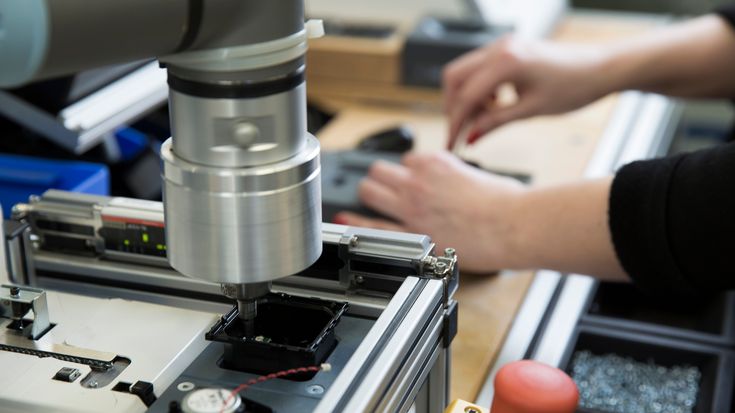
A screwdriving cell rests on four things. A feeder or presenter delivers screws to the tool, so the robot doesn’t pick them loose. A screwdriving system from a UR partner controls and records the torque, angle and result of every fastening. The part is held in a known position, with every screw reachable from the robot’s side. And the cell has a plan for a failed fastening, whether that’s retry, flag or reject, decided before it goes live.

Three manufacturers moved screwdriving to cobots

Albrecht Jung (JUNG), Germany

Small screws on digital radios

JUNG makes electrical installation and building technology products. It started with one cobot in a research project, then added another to assemble components of digital radios. The operator at that station described the change:

JUNG’s own employees program the cobots and build the applications themselves, and the plant was moving to eight UR robots in total, including packaging.

What it shows: for small fasteners, a cobot takes over the part of the job that strains people and causes slips, and the operator moves on to the next task.

Read more

I used to have to fasten the screws by hand. That was often a tricky job, because they are quite small - sometimes I slipped. Work has become so much safer for me thanks to the UR3. In addition, I save valuable time per operation - and can assemble considerably more parts.

An operator

JVC Electronics Indonesia

Seven UR3 cobots on a 400,000-unit-a-month operation

Part of the JVCKENWOOD Group, JEIN ran the same manual processes for 20 years. It deployed seven UR3 cobots for screwdriving, soldering, and pick and place. The cobots stabilized takt time and halved the time per task, and JEIN reports operating costs down by more than USD 80,000 a year, with a 30-month return on investment. Training took four days.

What it shows: a plant new to robotics can start with screwdriving, reach a steady takt time and build a case for rollout across a group.

Read more

Siemens Gerätewerk Erlangen

Screwdriving among 70+ applications

Screwdriving is one of the tasks Siemens’ cobots take on, alongside assembly, gluing and testing. More on Siemens below.

Read more

Application 2: Insertion and fitting reward planning

This is the broader family of fitting work: placing a display into a housing, joining sub-assemblies, applying adhesive, soldering a connection or pressing a part home. Each needs the part in the right place and, often, the right amount of force.

What a fitting cell needs

A fitting cell needs parts presented consistently, in trays or fixtures, or located with vision when they vary, and a tool for the job, such as a gripper, dispenser or soldering tool. Force sensing lets the cobot feel a part seat and hold the same insertion profile every time. UR cobots have a built-in force mode for contact tasks, and developers building advanced force control can use Direct Torque Control. Because many fitting steps sit next to manual work, the risk assessment shapes the layout.

Manufacturers moved fitting work to cobots

Siemens Gerätewerk Erlangen, Germany

Fom one cobot to more than 70.

The plant makes industrial controls, drives and frequency converters in small and medium volumes. Its first cobot, a UR10, started in 2017 moving cartons to a pallet. Today more than 70 cobots handle assembly, screwdriving, quality inspection, dispensing and gluing. Siemens plans every application as a digital twin and commissions it virtually before it reaches the floor. To bring employees on board, it held an information day where staff could try the cobots; production areas have since given their cobots names.

What it shows: in small-to-medium volume electronics, cobots can scale from one cell to a plant, when planning is done up front and the team builds in-house skills.

The key to success was that we realized the planning and implementation with our own specialists from technology, production, and maintenance. Today, the other Siemens sites are benefiting from our experience with the cobots

Michael Brucksch, Head of Automation Implementation, Siemens

JVC Electronics Indonesia

Fitting displays and soldering.

Beyond screwdriving, JEIN’s UR3 cobots attach glass displays to car stereo units and take on soldering, a task that also took workers away from fumes.

What it shows: one cobot model can cover several assembly tasks by changing the tool.

The cell can check its own work

An assembly cell can also confirm its own work before the part moves on, so a defect stops where it starts. The screwdriving system records each fastening; a camera can confirm a part is present and seated; and the force profile of an insertion shows whether the part went home.

For stand-alone test stations, see the PCBA handling guide.

Material Handling

Is your assembly step a good candidate?

Answer these about one assembly step on your line:

  • How many screws or parts per unit, and how many types?

  • Can every screw or part be reached from one side?

  • What torque or force is specified, and how is it verified today?

  • How do parts arrive: in trays, fixtures or loose?

  • How many product variants run through the step, and how often do you change over?

  • What escapes from this step to test or the field today?

  • What are your weekly volumes?

A defined fastening or fit, parts that arrive the same way each time and a spec you can check make a strong first candidate.