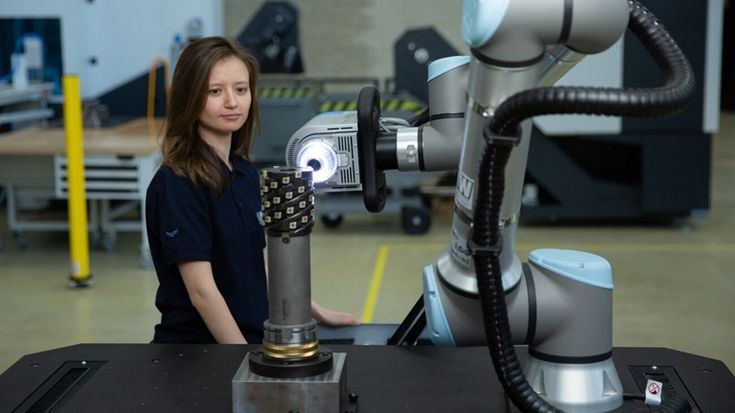
Mechanical Design of Robotic Arm
The mechanical design of a robotic arm, which was inspired by the human hand, consists of several connections that together comprise a kinematic chain. The joints that connect the links provide the system with its rotational and translational movement capabilities. An end effector is also usually added to the end of the wrist-joint where a human hand would be on a human arm.
Degrees of Freedom
In robotics arm design, the degree of freedom (DoF) of a robot is calculated by subtracting the number of constraints on its mobility from the total number of freedoms of the rigid body. The joints are usually the reason for these mobility restrictions.
Examples of joints that only allow one degree of freedom between the two bodies they link are revolute and prismatic joints. Joints that have more than one degree of freedom include spherical joints that have three relative degrees of space and universal joints that have two.
A robotic arm can be described by its degree of freedom. A bigger number indicates increased flexibility in aligning a tool, making it a significant parameter for robotic arm design. Take the case of a serial robot, where the number often refers to the number of single-axis rotating joints in the arm.
The end effector is positioned with five degrees of freedom in serial and parallel manipulator systems, consisting of three translational DoF and two for orientation. Thus, a direct relationship between actuator position and manipulator setup may be found.
Robot Workspace
The collection of all places that the end effector can reach is the robot workspace, sometimes referred to as accessible space. The link lengths, rotational and translational restrictions, the general design of the mechanism, and other factors all affect the workspace. By altering the connection lengths and permitted degrees of freedom for the mechanism, the work volume produced in this way specifies the usable space for the robot.
Electronics Design of Robotic Arm
Servo Motor Control
Servos can be either AD (battery-driven) or DC (input power source) motors. Servo motors often offer excellent torque to inertia ratios thanks to an internal gearing arrangement. Due to the feedback control loop, accuracy is relatively high.
Small and portable DC servo motors are popular for use in toys, educational robotic applications, and RC planes. Servo motors typically have a rotational limit of between 90 and 180 degrees. However, certain motors can provide more angular motion.
Due to their ability to deliver a high degree of spatial orientation precision, servo motors are an excellent choice for use in robot arms and legs, rack and pinion steering, and sensor scanners. Since these servos are entirely self-contained, setting up the velocity and angle control loops is straightforward.
Servo Wiring
Servo motors typically have three wires: The colour of the ground—black or brown—identifies it. "Red" serves to identify power. Signal wire can be distinguished by its yellow, orange, or white colour (3-5V).
Servo Voltage (Red and Black/Brown wires): The average working voltage range for servo motors is 4.8 to 6 volts. While certain Hitec servo motors are also available that work at a greater rated voltage, most micro-sized servo motors run at a lower voltage.
Signal Wire (Yellow/Orange/White wire): The black and red wires supply the servo motor with electricity, but the signal wire transmits the commands used to control the servo. A logic square wave of a certain wavelength (often 50 Hz) is typically transmitted to the servo, which causes it to be oriented at a given angle because the wavelength precisely corresponds to the servo angle. For instance, the Arduino Mega receives i/ps from the PC to produce a square wave, which then regulates the servomotor's angular direction.
Microcontroller (Basic Concept of Arduino)
Servo motors use microcontrollers to regulate their accuracy and angular position. One example is the single-board microcontroller, an Arduino, which can be configured to suit the application. It has on-board I/O structures, and USB power connectors, and is designed for an Atmel AVR CPU.