

Bene Solutions integrates heavy-load depalletizing with shape recognition
Bene Solutions
In short
Bene Solutions, an industrial integrator positioned in the industrial process automation market for over 40 years, has implemented the COBOT++ project within Saunier Duval. Having required nearly two years of development, the project brings together Bene Solutions, Saunier Duval and IRT Jules Verne, among others, and meets a dual objective: to enable a robot to collaborate safely with human operators and to lift loads of 20kg and more. It is one of the most complex projects carried out to date by Bene Solutions
Ergonomic and safety optimization in heavy-load depalletizing at Saunier Duval
The project originated from the desire of the Saunier Duval company to improve the ergonomics of a workstation where operators lifted up to 2 tonnes per day with repetitive movements and awkward postures.
Specifically, the application was integrated by Bene Solutions at Saunier Duval's Nantes site, which specializes in the production of boilers, solar panels, and heat pumps, but is also the company's R&D center. With 35,000 units produced annually and 560 employees at the Nantes site, Saunier Duval needed a cobotics solution to improve the ergonomics of the workstations to which operators were exposed.
The project involved depalletizing boiler blocks for assembly by an operator. It presented several challenges, particularly in terms of load handling, operator cooperation, workplace safety, and shape recognition. A complex project and a major challenge, Bene Solutions was able to bring all its expertise as an integrator of collaborative robotics applications, based on its extensive experience in industrial automation.
Bene Solutions
Main value drivers:
Capacity to develop applications around the cobot Simplicity and intuitiveness of programming Safe operation alongside the operator who keeps control
Tasks solved by collaborative robots:
Quality inspection Depalletization Assembly
Automation challenges solved:
Increasing the cobot's load capacity with a balancer Management of acceleration and deceleration of balancer movements Shape recognition via sensor Reduction of MSDs among operators Traceability of each part by scanning a QR code
How they did it
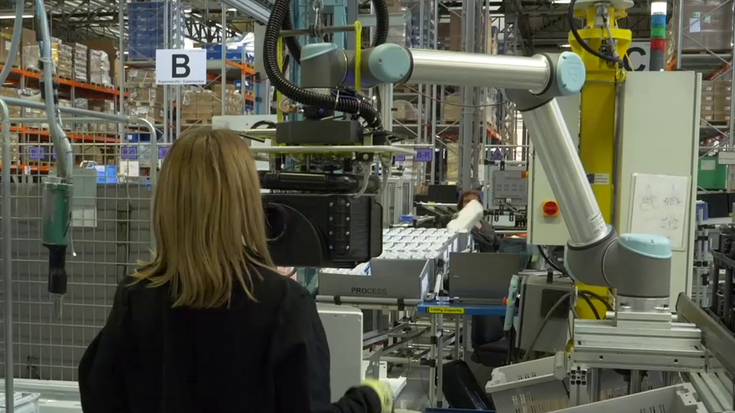
Intelligent heavy-load handling with cobotics and shape recognition
To address the ergonomic and operational challenges at Saunier Duval, Bene Solutions, in close collaboration with IRT Jules Verne (Nantes), developed a sophisticated cobotic solution combining precision, safety, and adaptability.
At the heart of the system is a Universal Robots UR10 cobot, integrated with a mechanical load balancing system to safely handle large and heavy parts. This setup is further enhanced by a SICK PIM60 camera and a shape recognition sensor, enabling the robot to identify and interact with parts accurately.
During the depalletizing process, the cobot uses its vision system to:
- Recognize the gripping area of each part
- Securely lift and balance the load
- Present the part to the operator for further assembly
This intelligent collaboration between human and machine ensures safe handling of loads exceeding 20 kg, reduces physical strain on operators, and maintains high throughput and precision—marking a significant advancement in industrial ergonomics and automation.
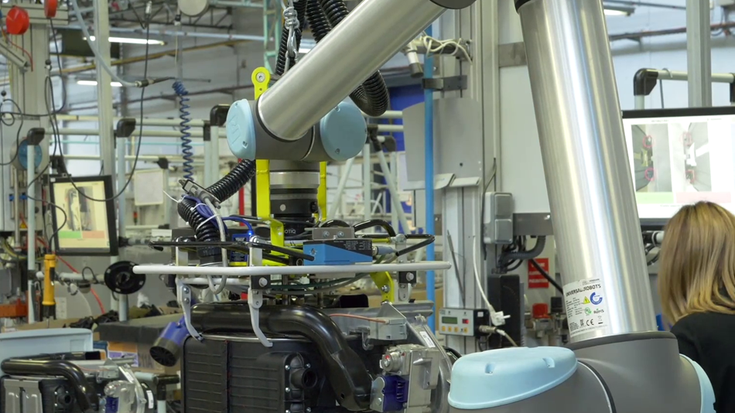
Carrying loads over 20kg
To optimize the load capacity of the UR10 cobot , the application integrates a balancer that takes over the load above the cobot. Thus, the cobot can lift up to three times the load normally carried, or more than 20 kg. The balancer is controlled by the cobot, which is particularly difficult when it comes to managing the acceleration and deceleration of the balancer's movements. For these technical points, Bene Solutions was able to count on the support of the R&D teams at IRT Jules Verne.

Precision in moving parts via a sensor
During depalletizing, with a shape recognition function via a sensor, the collaborative robot recognizes the gripping area, takes the load and presents it to the operator
Successful human-robot cooperation
The cobot makes the load available to the operator by offering a system that allows them to regain control at the end of the positioning cycle. The safety relationship is ensured by a light signal (color code). Depending on the color, the operator knows if they have control over the cobot. At this moment, the cobot becomes inert (its motors are inactive) and can be easily moved to help the operator correctly position the load on the support. It presents no danger to the operator who decides to restart it when she has finished her cycle so that it can go and get the next part.
Traceability
Bene Solutions has integrated a camera that scans the QR code of each block used and sends this information to the company's information system to enable traceability of the parts.
Transforming workstation ergonomics and efficiency with cobotic innovation
The application developed by Bene Solutions fully meets the initial objectives of the project, on the reduction of load carrying (up to 2 tonnes per day) and the reduction of ergonomic problems and MSD risks for operators .
The operator can focus on higher-value tasks, such as positioning the part during assembly, leaving the more arduous tasks of depalletizing and handling heavy loads to the cobot. She can then free up 90% of her time for value-added tasks . In addition, workstation safety has been greatly improved. The safe coexistence between the operator and the UR10 cobot is the key to the success of this application.
The project required a total of nearly 2 years of R&D and the return on investment (ROI) of the project is estimated at 18 months . This application allowed Saunier Duval to carry out a full-scale POC in an effort to enable the development of similar solutions in other sites of the group.
Loïck ANGER, Managing Director of Bene SolutionsThe safe cohabitation between the operator and the UR is the key to the success of this application – 90% of the cycle, without added value and with risks of musculoskeletal disorders (MSDs), is provided by the UR
the application integrates a balancer that takes over the load above the cobot
The cobot makes the load available to the operator by offering a system that allows them to regain control at the end of the positioning cycle
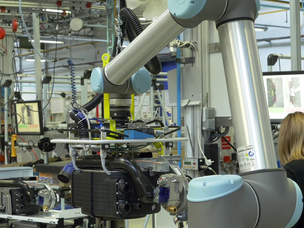
With a shape recognition function via a sensor, the collaborative robot recognizes the gripping area, takes the load and presents it to the operator
Get in touch with Universal Robots
Thousands of businesses rely on Collaborative Robots to...
- Increase productivity
- Adapt to changing product demand
- Improve employee well-being and retention
- Staff through labor shortages
- Universal Robots USA, Inc
- 27175 Haggerty Road, Suite 160
- 48377 Novi, MI