

Oliva Torras increases welding capacity by up to 50% while maintaining flexibility in high-mix production
Spanish manufacturer scales welding and polishing operations with a UR20-1750 collaborative robot—without compromising adaptability
The challenge
Key Challenges
- High variability from small and medium batch production
- Increasing demand for higher volumes and shorter lead times
- Difficulty recruiting qualified welders
- Need to scale without losing flexibility
Founded in 1945 in Manresa, Oliva Torras began as a subcontractor of metal components for machinery manufacturers. Over time, the company diversified into six business divisions, developing its own products and engineering projects across sectors including ATMs, railway interiors, compressor systems, and industrial ventilation components.
Operating in industries with stringent quality requirements—such as railway—has driven continuous process optimization and certification, particularly in welding. By managing the full value chain internally, from metal fabrication to painting, assembly, and final testing, Oliva Torras maintains full control over quality and delivery.
A defining characteristic of the company is its focus on small and medium production batches. This high level of customization creates significant variability in production requirements, making adaptability a critical competitive advantage.
However, once prototypes are approved and initial series are successfully delivered, customers demand higher volumes and shorter lead times. This creates the need to seamlessly balance flexibility with increased and consistent production capacity.
To address this challenge, Oliva Torras turned to collaborative automation. Compared to traditional robots, industrial collaborative robots offered a more ergonomic, compact, and easily configurable solution for environments where frequent adjustments are required.
The company had prior experience with a plug-and-play welding solution based on a UR cobot, which delivered consistent performance over five years without production downtime. Building on this success, Oliva Torras sought to expand automation capabilities to handle larger components and additional processes such as polishing, while maintaining fast and intuitive programming for frequent changeovers.
The solution
Solution overview
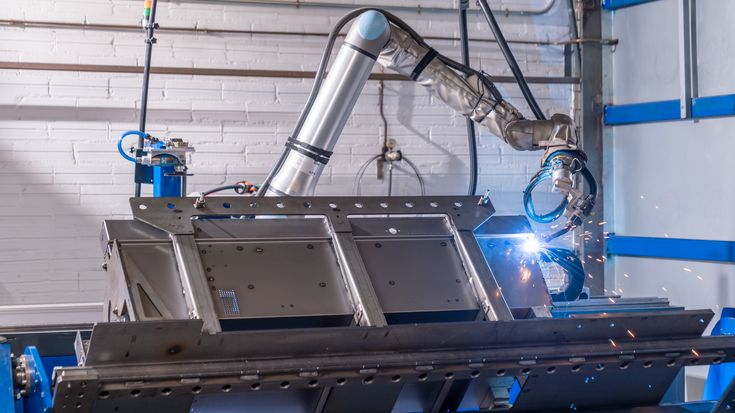
- UR20-1750 collaborative robot for welding and polishing
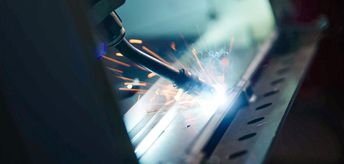
- Integrated MIG/MAG welding and automated polishing
Key capabilities delivering value
- 1,750 mm reach + 25 kg payload → Handles larger parts without repositioning
- Compact footprint → Fits easily into existing production setup
- URCaps ecosystem → Seamless integration and single interface control
- Automatic tool changing → Eliminates manual intervention between processes
Universal Robots was the preferred choice due to its strong market presence and extensive ecosystem.
The project was implemented together with Sokad Soluciones Mecánicas, a certified integrator, who developed a solution combining MIG/MAG welding and polishing of carbon steel, aluminum, and stainless steel.
The system integrates:
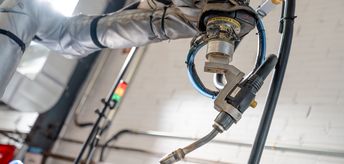
- A Böhler welding torch and wire feeder via URCaps
- A Dynabrade automated polishing tool
- An automatic tool changer
- A Robotiq force control system
- A rotary table enabling full access to welding positions across 2–2.5 meters
Installation and commissioning were completed rapidly, with initial welding operations starting within a week.
Albert Rubirola, Operations Manager at Sokad.Working with Universal Robots has made it easy to integrate technologies from different suppliers. URCaps allows tools to be easily integrated into the robot software, enabling the operator to control all technologies from a single interface
High productivity through human-robot collaboration
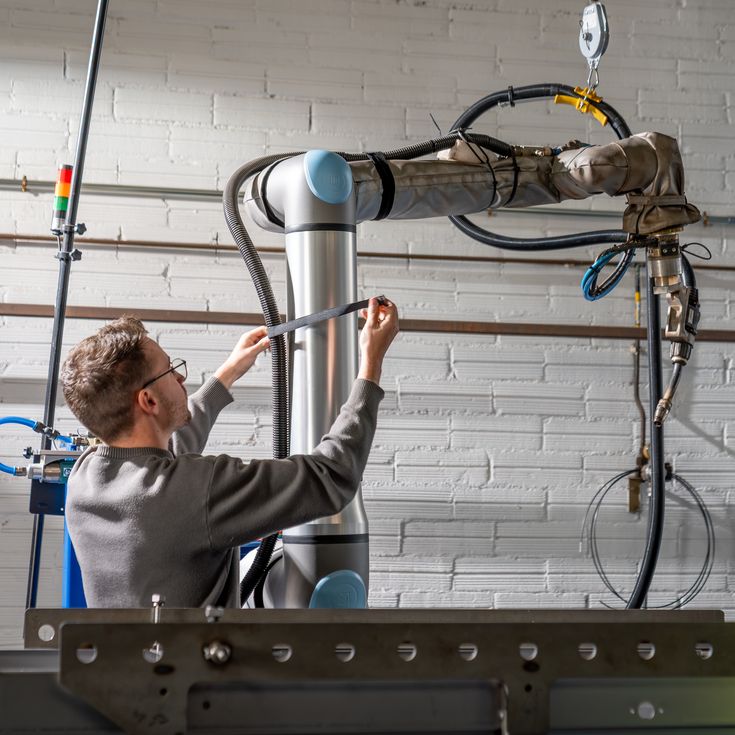
While the robot performs welding or polishing, operators can prepare or finish other parts in parallel.
Although the robotic cell remains restricted during operation for safety reasons, operators work alongside the system, enabling efficient parallel workflows.
This human-robot collaboration has increased productivity by up to 50%, effectively doubling output with a single system.
Enabling workforce evolution
Collaborative automation is also supporting workforce development. Employees are able to acquire new skills, with training requirements remaining accessible and straightforward.
As a result, Oliva Torras is expanding the use of industrial collaborative robots to additional processes, including sealing and bonding.
Thanks to their flexibility and ease of programming, these robots are not limited to a single product, but can be redeployed across multiple applications—supporting the company’s ability to respond to complex, high-mix production demands.
Looking ahead, collaborative automation is set to play a key role in enabling Oliva Torras’ strategy of diversification, international growth, and local manufacturing.
Automation challenges solved
Small and medium batch production with high variability Fast and simple reconfiguration for new production runs Seamless transition from welding to polishing via automatic tool change Handling medium-sized parts between 1.5 and 2 meters Parallel human-robot workflows to increase productivity by approximately 50%
Value drivers
Easy programming and fast deployment Accessible technology for operators Seamless integration of welding and polishing technologies Extended reach for larger components Continuous, uninterrupted production
Tasks automated
Welding Polishing
Get in touch with Universal Robots
Thousands of businesses rely on Collaborative Robots to...
- Increase productivity
- Adapt to changing product demand
- Improve employee well-being and retention
- Staff through labor shortages
