

Imitation learning is reshaping the training of physical AI for industrial environments
Imitation learning is changing how industrial robots are trained, shifting from rigid programming to learning through real-world interaction. Anders Billesø Beck explains why data quality, force and production-grade hardware matter.
For decades, industrial robots have been programmed. Every motion defined. Every edge case anticipated. That approach works well until robots are asked to do more than repeat the same task, the same way, every time.
As AI moves from perception into physical execution, robots are increasingly expected to deal with contact, variation and uncertainty. These are not problems that lend themselves easily to rules or scripts. They are learned through experience.
This is where imitation learning comes in.
Imitation learning allows robots to learn tasks by observing and reproducing human demonstrations. Instead of programming every step, engineers physically guide a robot through a task and capture the data generated during real interaction with the world. That data becomes the foundation for training AI models that can reason, adapt and act in physical environments.
At Universal Robots, imitation learning has become a central pillar of how we think about Physical AI and a critical component in the way we approach the development of robotics designed to work on real factory floors.
The real challenge is data quality
Much of today’s AI conversation focuses on models: foundation models, Vision‑Language‑Action (VLA) models, reinforcement learning. But in practice, progress is often constrained by something more fundamental — the quality of the data used to train those models.
Industrial tasks generate complex, interdependent signals. Motion alone is not enough. Contact forces, compliance, tool interaction, visual context and subtle variations in how tasks are performed all matter. If those signals are missing, delayed or inferred indirectly, models struggle to generalize — no matter how advanced the architecture.
Imitation learning matters because it enables high‑fidelity data capture grounded in real physical interaction. When done well, it produces datasets that reflect how tasks are actually performed, not how they were assumed to be performed.
Moving beyond lab‑only experiments
Many imitation learning setups today rely on VR controllers, fragile research robots or custom lab rigs. These approaches can be effective for experimentation, but they rarely translate cleanly into industrial environments.
Training on one type of hardware and deploying on another introduces friction, delays and unexpected failure modes. Force signals behave differently. Dynamics change. What worked in the lab could easily break down on the factory floor.
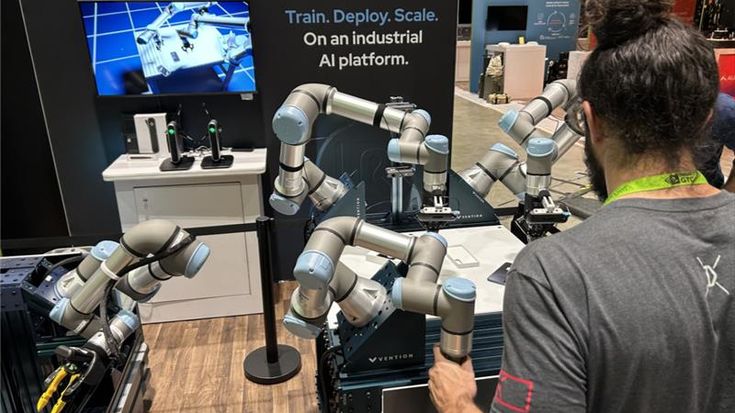
At NVIDIA GTC 2026, Universal Robots introduced a different approach: training on the same industrial robots that will later run the AI models.
The goal is simple but important. If imitation learning is to become practical at scale, data needs to be captured on production‑grade hardware, under real conditions, using the same robots customers rely on every day.
Introducing the UR AI Trainer
To support this shift, Universal Robots has developed the UR AI Trainer — a dedicated imitation learning system designed specifically for industrial data collection.
The UR AI Trainer is built around a leader-follower robot configuration, where a human operator physically guides a “leader” robot while a synchronized “follower” robot mirrors the motion in real time. During each demonstration, the system automatically captures synchronized motion, force, torque and visual data.
This is not a loose integration or a research prototype. It is a ready‑to‑deploy system that combines robots, compute, sensors and software into a single, coherent platform.
Why force and control matter
At the core of the UR AI Trainer is real‑time, torque‑aware control. Using Direct Torque Control and force feedback, operators can guide robots through tasks with natural, compliant motion.
Contact is treated as a first‑class signal, not something inferred after the fact. Forces are measured directly. Subtle interactions — how much pressure is applied, how a tool engages with a surface — are captured as part of the dataset.
For many industrial tasks, this level of physical fidelity is the difference between a model that looks promising in simulation and one that performs reliably in production.
Seeing and acting at the same time
Motion and force data alone are not enough. To train VLA models, perception and action need to be tightly coupled.
The UR AI Trainer captures synchronized multi‑camera vision data, aligned precisely with robot state and force signals. This produces datasets where visual context, physical interaction and robot motion are recorded as a single, coherent sequence.
The result is training data that reflects how robots actually see, reason and act in the physical world — not fragmented streams stitched together after the fact.
Built for modern AI workflows
Data capture is only useful if it fits into real AI development pipelines. The UR AI Trainer runs on the UR AI Accelerator and integrates Scale AI’s software to manage data capture, structuring and preparation for model training.
This allows teams to move cleanly from demonstration to dataset, and from dataset to model fine‑tuning, without building custom pipelines or tooling.
To reduce setup time, the system is delivered on a production‑ready hardware platform developed with Vention, providing a stable and repeatable foundation for multi‑robot leader–follower configurations.
From datasets to deployed AI
The value of imitation learning lies in what it enables next. High‑quality datasets can be used to train and fine‑tune VLA models, improve robustness across real‑world variation and reduce the gap between simulation and deployment.
Through collaboration with Scale AI and AI model partners, Universal Robots is also exploring how industrial task datasets collected on UR robots can support a broader ecosystem — accelerating progress in Physical AI beyond individual projects.
Why this matters now
Imitation learning is not new. What is new is the ability to apply it at industrial scale, using production‑grade robots and integrated AI infrastructure.
As AI systems take on more complex physical tasks, success will depend as much on how data is created as on how models are designed. Imitation learning is how that data gets created — and systems like the UR AI Trainer are what make it practical.

- Universal Robots USA, Inc
- 27175 Haggerty Road, Suite 160
- 48377 Novi, MI