

7 tips to choose the right vision system for your robot
A practical guide to 2D versus 3D, lighting, cycle time and open-platform vision integration for robots for manufacturers struggling with vision integration.
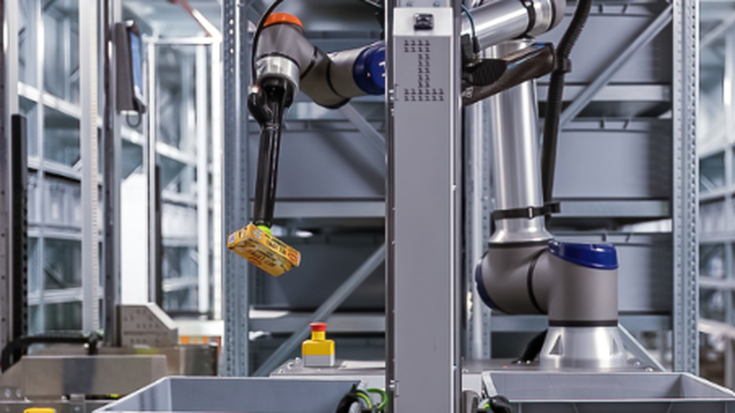
Machine vision is transforming automation, but selecting the right system can feel overwhelming. With dozens of options, varying specs, and integration challenges, the wrong choice can lead to costly downtime and inefficiencies for manufacturers. The stakes are high: vision affects accuracy, cycle time and overall ROI.
Machine vision is just one piece of the puzzle. To unlock even greater efficiency, manufacturers are turning to AI-powered tools like the AI Accelerator to help optimize cobot performance and decision-making.
7 expert tips for choosing the right vision system
1. Confirm if vision is truly needed
Not every task requires machine vision. Simple palletizing or grid-based picking often works with built-in tools or sensors. Deploy vision only when precision, variability, or safety demands it.
2. Define your application clearly
Vision tasks typically fall into three categories:
Location & Path Planning: Accurate object recognition and pose estimation.
Inspection: Detecting defects or verifying quality.
Safety: Monitoring human presence in the robot’s workspace.
3. Choose between 2D and 3D cameras
2D Vision: Ideal for barcode reading, label orientation, and basic sorting.
3D Vision: Essential for depth, volume, and surface inspection—perfect for precision assembly or microchip manufacturing.
4. Match precision to your tolerance
High-resolution cameras are critical for tight tolerances. For less demanding tasks, cost-effective systems may suffice. Don’t overinvest where it’s not needed.
5. Account for lighting conditions
Lighting can make or break vision performance.
Ask: Can the system handle variable ambient light? Does it provide its own illumination? Even small changes in lighting can disrupt results.
6. Align processing speed with cycle time
High-speed applications require fast image capture and processing. Factor this into your cycle time calculations to avoid bottlenecks. Pairing vision systems with AI-driven optimization tools—such as UR’s AI Accelerator—can further reduce bottlenecks and improve throughput.
7. Ensure open platform compatibility
Choose robots that integrate easily with multiple vision solutions. UR’s’ open platform and UR+ ecosystem make this simple, futureproofing your investment and reducing integration headaches.
How Universal Robots makes vision integration easy
Universal Robots (UR) cobots are designed for seamless compatibility with leading vision systems like Photoneo and Datalogic.
In the case of DCL Logistics, UR cobots paired with Datalogic vision cameras to streamline SKU verification. When a product is picked, the camera checks the SKU and sends a “Pass” or “Fail” signal. If incorrect, the cobot redirects the item to a reject bin —boosting accuracy and efficiency without slowing operations.
Read the case story
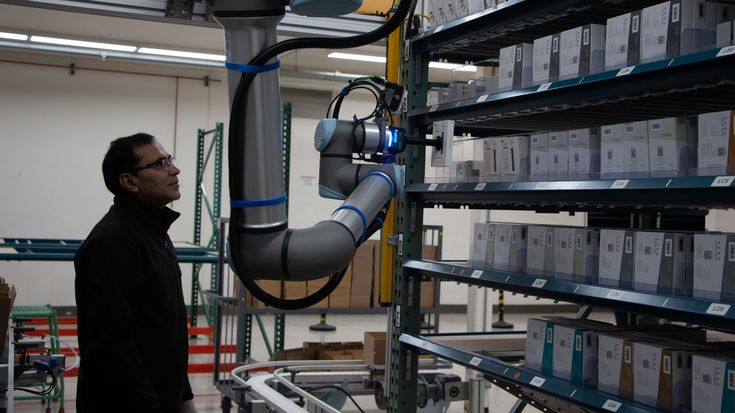
Proven performance at first glance
UR+ partner Photoneo’s MotionCam3D enables fast 3D object modeling for manufacturing validation, quality control and further processing.
Machine Vision FAQs
Do all robot applications need machine vision?
No. Simple tasks like grid-based palletizing often work without vision systems.
When should I choose 3D over 2D vision?
Opt for 3D when depth, volume, or surface inspection is critical.
How does UR support vision integration?
UR’s open platform and UR+ ecosystem ensure compatibility with leading vision solutions.
Book a Demo
Ready to see how machine vision can transform your production line? Book a demo today.
Explore how AI and vision work together to boost productivity: https://www.universal-robots.com/products/ai-accelerator/
Key takeaways
- Machine vision transforms robots into intelligent partners for precision tasks.
- Not all applications need vision—define your use case first.
- 2D vision suits simple tasks; 3D vision is essential for depth and inspection.
- Lighting and processing speed can make or break system performance.
- Open-platform robots like Universal Robots simplify integration and futureproof investments.

- Universal Robots USA, Inc
- 27175 Haggerty Road, Suite 160
- 48377 Novi, MI