Dimensioning the Stand

Description

The structure (stand) on which the robot arm is mounted is a crucial part of the robot installation. The stand must be sturdy and free of any vibrations from external sources.


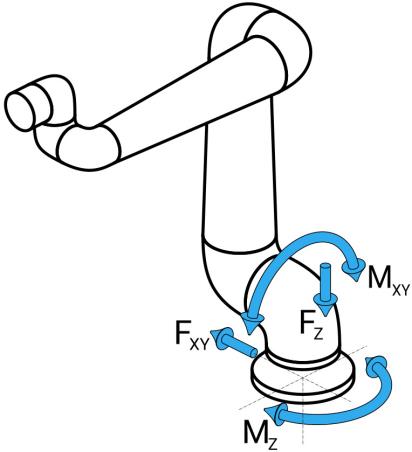
Each robot joint produces a torque that moves and stops the robot arm. During normal uninterrupted operation and during stopping motion, the joint torques are transferred to the robot stand as:

  • Mz: Torque around the base z axis.

  • Fz: Forces along base z axis.

  • Mxy: Tilting torque in any direction of the base xy plane.

  • Fxy: Force in any direction in the base xy plane.


Force and moment at base flange definition.


Dimensioning the Stand

The magnitude of the loads depends on robot model, program and multiple other factors.

Dimensioning of the stand shall account for the loads that the robot arm generates during normal uninterrupted operation and during category 0, 1 and 2 stopping motion.


During stopping motion, the joints are allowed to exceed the maximum nominal operating torque. The load during stopping motion is independent of the stop category type.

The values stated in the following tables are maximum nominal loads in worst-case movements multiplied with a safety factor of 2.5. The actual loads will not exceed these values.

Robot Model

Mz [Nm]

Fz[N]

Mxy[Nm]

Fxy [N]

UR5e

450

1090

750

910

Maximum joint torques during category 0, 1 and 2 stops.


Robot Model

Mz [Nm]

Fz[N]

Mxy[Nm]

Fxy [N]

UR5e

380

950

630

750

Maximum joint torques during normal operation.

The normal operating loads can generally be reduced by lowering the acceleration limits of the joints. Actual operating loads are dependent on the application and robot program. You can use URSim to evaluate the expected loads in your specific application.

Safety margins

You can incorporate added safety margins, factoring in the following design considerations:


  • Static stiffness: A stand that is not sufficiently stiff will deflect during robot motion, resulting in the robot arm not hitting the intended waypoint or path. Lack of static stiffness can also result in a poor freedrive teaching experience or protective stops.

  • Dynamic stiffness: If the frequency of the stand matches the movement frequency of the robot arm, the entire system can resonate, creating the impression that the robot arm is vibrating. Lack of dynamic stiffness can also result in protective stops. The stand should have a minimum resonance frequency of 45 Hz.

  • Fatigue: The stand shall be dimensioned to match the expected operating lifetime and load cycles of the complete system.

  • Potential for tip-over Hazards.

  • The robot arm's operational loads can cause movable platforms, such as tables or mobile robots, to tip over, resulting in possible accidents.

  • Prioritize safety by implementing adequate measures to prevent the tipping of movable platforms at all times.

  • If the robot is mounted on an external axis, the accelerations of this axis must not be too high.

    You can let the robot software compensate for the acceleration of external axes by using script command:
    set_base_acceleration()

  • High accelerations can cause the robot to make safety stops.