Maximum Payload
| Description |
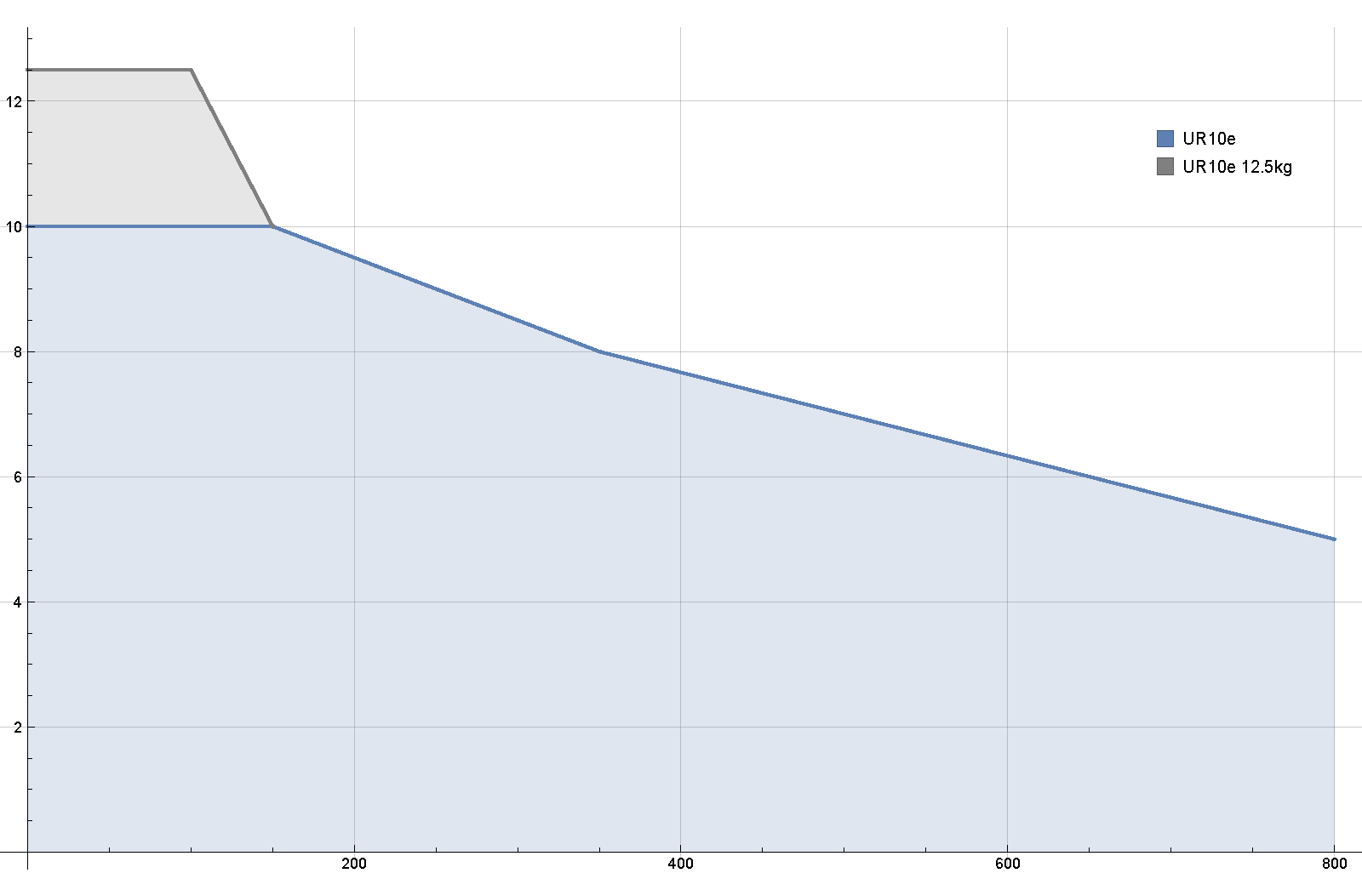
The rated payload of the Robot Arm depends on the center of gravity offset of the payload, see Figure Mechanical Interface The center of gravity offset is defined as the distance from the center of the tool flange to the center of gravity of the attached payload. When computing the payload mass in a pick and place application, for example, consider both the gripper and object handled by the gripper.
|
| UR10e10 kg / 12.5kg |
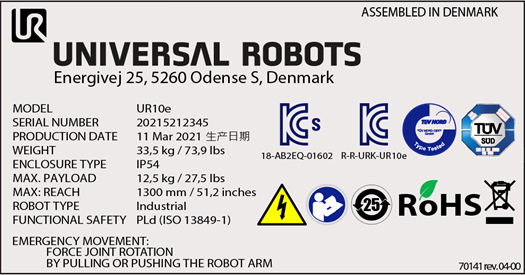
You can verify the payload capacity of the robot by checking the label on the robot arm, as illustrated below.
|
6.3: The relationship between the rated payload and the center of gravity offset.
|
| Payload Inertia |
The robot can be used with high inertia payloads. The control software automatically adjusts accelerations, if you correctly enter the following in PolyScope (see:Set Payload ):
You can use the URSim to evaluate the accelerations and cycle times of the robot motions with a specific payload. |