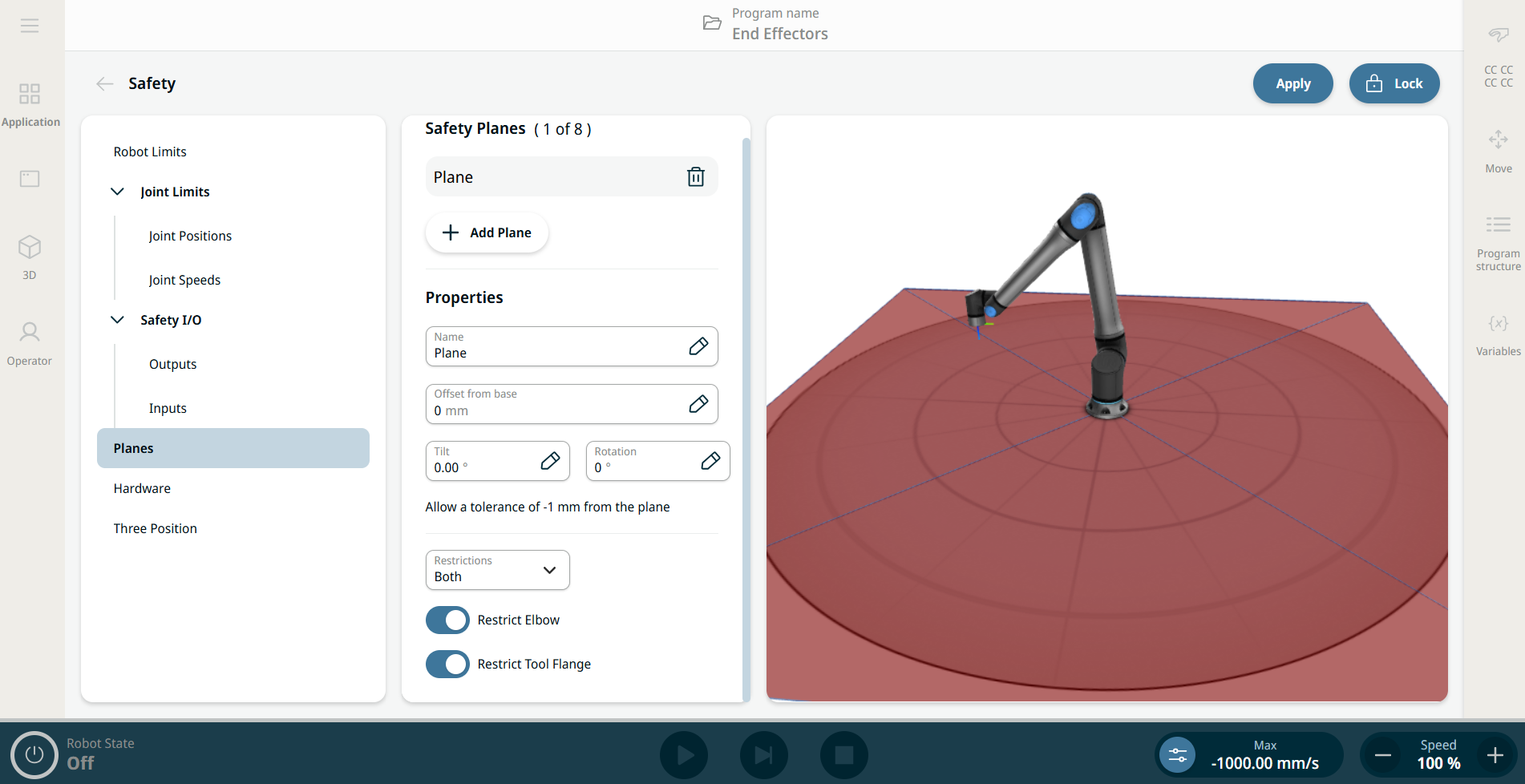
Safety Planes

Description

Safety planes restrict robot workspace, the tool, and the elbow.

Defining safety planes only limits the defined Tool spheres and elbow, not the overall limit for the robot arm.

Defining safety planes does not guarantee that other parts of the robot arm will obey this type of restriction.

Figure 2.4:  PolyScope X screen displaying safety planes.


Configuring a Safety Plane

You can configure safety planes with the properties listed below:

  • Name. This is the name used to identify the safety plane.

  • Offset from base. This is the height of the plane from the base, measured in the Y direction.

  • Tilt. This is the tilt of the plane, measured from the power cord.

  • Rotation. This is the rotation of the plane, measured clockwise.

You can configure each plane with the restrictions listed below:

  • Normal. When the safety system is in Normal mode, a normal plane is active and it acts as a strict limit on the position.

  • Reduced. When the safety system is in Reduced mode, a reduced mode plane is active and it acts as a strict limit on the position.

  • Both. When the safety system is either in Normal or Reduced mode, a normal and reduced mode plane is active and acts as a strict limit on the position.

  • Trigger Reduced Mode. The safety plane causes the safety system to switch to Reduced mode if the robot Tool or Elbow is positioned beyond it.


Elbow Joint Restriction

The feature is enabled by default.

You can use Restrict Elbow to prevent robot elbow joint from passing through any of your defined planes.

Disable Restrict Elbow for elbow to pass through planes.


Tool Flange Restriction

Restricting the tool flange prevents the tool flange and the attached tool from crossing a safety plane. When you restrict the tool flange, the unrestricted area is the area inside of the safety plane, where the tool flange can operate normally.

The tool flange cannot cross the restricted area, outside of the safety plane.

Removing the restriction allows the tool flange to go beyond the safety plane, to the restricted area, while the attached tool remains inside of the safety plane.

You can remove the tool flange restriction when working with a large tool off-set. This will allow extra distance for the tool to move.

Restricting the tool flange requires the creation of a plane feature. The plane feature is used to set up a safety plane later in the safety settings.